
On this housing stock, the charger is usually a board job first
EV Charger Installation in Belmont, Geelong
Belmont is mostly postwar housing that has had three generations of appliances added to wiring designed for one. The stock is predominantly 1950s to 1970s weatherboard and brick veneer, and on a meaningful share of it the original board is still doing the work.
- Belmont 3216
- Powercor network
- REC 37223
The short answer
EV charger installation in Belmont 3216 is usually two jobs. Belmont is predominantly 1950s to 1970s weatherboard and brick veneer, and a fair number of those homes still have ceramic fuses rather than breakers behind the board door, so a $800 to $3,500 switchboard replacement comes before the $1,200 to $2,200 charger install. Powercor is the distributor and the streets are single phase. Blocks of 550 to 750 square metres give narrow but usable side access.
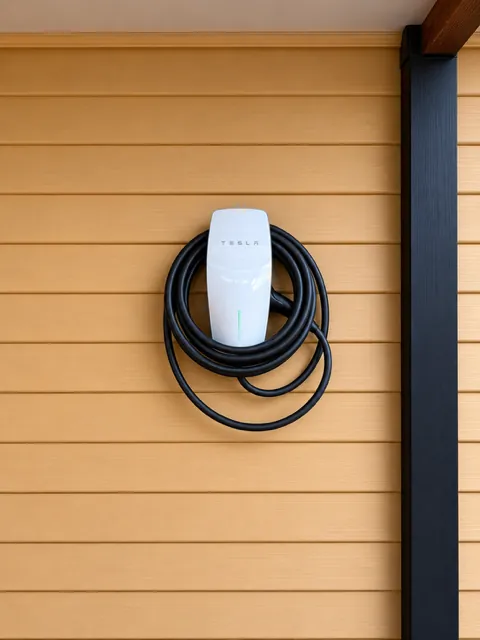
From one of our jobs
A Tesla Wall Connector on a dedicated 32A circuit
Photographed on site in Melbourne’s west. REC 37223.
That means an EV charger here is often a two part job, and we would rather set that out at the quote than surprise you on the day. The physical side is usually easy. Blocks run 550 to 750 square metres on 15 to 18 metre frontages with a driveway down one boundary, so the car is off the street and the run is short.
Ceramic fuses and what they mean for a charger
A fair number of Belmont boards still have ceramic fuse carriers you pull out by hand. There is no residual current protection, no spare way, and a main switch sized when the biggest load in the house was a bar heater. A 32A continuous charging circuit cannot go onto that, and nothing legitimate can.
Board replacement runs $800 to $3,500 depending on whether the meter panel and the consumer mains need attention too. We quote it as its own line. Half of it is the car, and half of it is thirty years of deferred electrical work that was going to have to happen the next time anything changed in the house.
Porcelain fuse carriers
If you pull them out by hand, budget for a board before you budget for a charger.
Consumer mains
A new board fed by 1950s mains still cannot carry the load. We check both, not just the board.
Quoted separately
$800 to $3,500 for the board, $1,200 to $2,200 for the charger, so you can see which is which.
Wired for a fraction of the load you now run
The 1950s and 60s houses here were wired for a household with a fridge, a radiator and a kettle. Since then most of them have picked up reverse cycle heating, an electric oven, a dishwasher and often a heat pump hot water service. Spare capacity, not spare ways, is usually the real constraint before an EV charger goes in.
We calculate the maximum demand against the actual appliance list rather than a rule of thumb. Where the numbers are tight, a load management device at $200 to $600 monitors total demand and throttles the charger instead of tripping the main switch on a cold evening with the heating running.
Maximum demand calculated
Against what is actually in the house, which on postwar stock is a lot more than the original design assumed.
Load management
$200 to $600, and far cheaper than a supply upgrade for a problem that only appears on peak evenings.
Charger current set at commissioning
We can configure a lower continuous current where the supply genuinely needs it, and record it on the certificate.
Narrow driveways and where the unit mounts
The standard Belmont block is 550 to 750 square metres on a 15 to 18 metre frontage with a driveway down one boundary. Side access is there but it is narrow, which is fine for a charger circuit and awkward for surface conduit that a car door will clip.
The cheapest arrangement is the charger on the house wall near the meter box, with the car parked on the driveway alongside. Where there is a garage or carport at the rear, the run is priced per metre, and overhead along a fence line is cheaper than underground where the property allows it.
House wall near the board
Shortest run and lowest price. Suits a car that parks on the driveway anyway.
Rear garage or carport
A submain priced per metre. Underground conduit is $60 to $120 per metre with trenching and reinstatement.
Mind the door swing
On a narrow Belmont driveway the conduit position has to clear a car door and a bin, which we mark on site.
Equipment height on the Barwon floodplain streets
Belmont Common sits on the Barwon floodplain and it has flooded before, most notably in 1952 and again in 1995. On the low-lying streets near the river that is a genuine consideration for where a charger, an isolator and a sub-board are mounted, and it is not something a generic quote will mention.
It is a cheap thing to get right. Mounting height on a garage wall costs nothing to change at installation and everything to change afterwards. On the higher streets away from the Common it is a non-issue, and we will tell you which side of that line your address sits on.
Low-lying river streets
Mounting height for the charger, isolator and any sub-board is set with the flood history in mind.
Free to get right
Height costs nothing at installation. Relocating equipment after a flood costs a great deal.
Not a blanket rule
The higher Belmont streets away from the Common do not need it, and we do not charge for precautions you do not need.
Single phase, the commute and the paperwork
Belmont streets are single phase on the Powercor network, so the ceiling is 32A and about 7.4kW, giving 40 to 50km of range per hour. A conversion to three phase on a postwar house that already needs a board is not a sensible spend, and we will say so rather than quote the bigger job.
Where home charging genuinely pays here is the Melbourne commute. A long daily round trip recovered overnight on an off peak schedule costs a fraction of what the same energy costs at a public charger, and that gap is what returns the installation cost rather than the charger itself.
32A single phase
About 7.4kW, or 40 to 50km per hour, which fills any car overnight from a quarter charge.
Off peak scheduling
Configured at commissioning so the car charges in the cheapest window automatically.
Certificate of Electrical Safety
Issued under REC 37223 with the commissioning current recorded, plus a 100% workmanship guarantee.
On the ground
Belmont specifics
- Postwar stock at this scale means original boards are common, and a fair number still have ceramic fuses rather than breakers behind the door. That is the single most likely reason a Belmont charger quote is higher than a Waurn Ponds one.
- The 1950s and 60s houses here were wired for a fraction of the current load, so spare capacity is usually the constraint before an EV charger or a heat pump goes in, even where the board itself is serviceable.
- Belmont Common sits on the Barwon floodplain and has flooded before, in 1952 and again in 1995. On the low-lying streets near the river, equipment mounting height is a real decision rather than a formality.
- Blocks of 550 to 750 square metres on 15 to 18 metre frontages with a driveway down one boundary mean side access is usually there but narrow, so conduit position has to clear a car door.
Free download
The Melbourne Home EV Charger Buyer's Guide
What a charger actually costs, how to tell whether you need three phase, and the six questions that separate a real quote from a cheap one. Four pages, no email required.
PDF · 4 pages · 2026 edition
Licensed and accredited work by a local team. Read about Pivot Trade Services or see recent jobs across the western suburbs.
Answers
Belmont questions
The board comes first. Ceramic fuse carriers mean no residual current protection, no spare ways and a main switch sized for a 1950s household, and a 32A continuous charging circuit cannot legitimately go onto that. Replacement runs $800 to $3,500 depending on the meter panel and consumer mains, and the charger install of $1,200 to $2,200 follows once it is done.
Because the house was wired for a fraction of what it now runs. A 1960s Belmont home carrying reverse cycle heating, an electric oven and a heat pump hot water service can be close to its single phase limit on a cold evening before a 32A charger is added. We calculate maximum demand and fit load management at $200 to $600 where the numbers are tight.
For where the equipment sits, yes. The Common is on the Barwon floodplain and flooded in 1952 and again in 1995. On the low-lying streets we set the charger, isolator and any sub-board higher on the wall, which costs nothing at installation. On the higher Belmont streets it is a non-issue and we do not add precautions you do not need.
That is the cheapest arrangement and it suits most Belmont blocks, because the driveway runs down one boundary and the car parks alongside the house anyway. The unit sits within a few metres of the board and the lead reaches. A rear garage turns it into a submain priced per metre, which is a bigger number.
Comfortably. It adds roughly 40 to 50km of range per hour, so a long daily round trip is recovered in a few hours overnight. Charging that commute at home on an off peak schedule costs a fraction of what it costs at a public charger, and that difference is what actually returns the installation cost.
Yes, on a scheduled basis. Belmont is about 65km from our Altona base and we book Geelong work in blocks, nominating the week rather than the hour. We do not offer same-day attendance at that distance. Powercor runs the network here and in our own area, so the load addition process is one we already use regularly.
Other work we do in Belmont
- Electrician in BelmontPostwar wiring carrying three generations of appliances
- Solar installation in BelmontGood roofs, tired switchboards
- Home battery in BelmontBoard work first, storage second
- Split system in BelmontPostwar wiring, modern load, one dedicated circuit at a time
- Heat pump hot water in BelmontBoard first, then the changeover
Get a Belmont quote
Tell us the address and what you need. We quote Belmont 3216 and the surrounding western suburbs in writing, with no obligation.
- Free
- On-site quotes
- Fixed
- Written pricing
- 100%
- Workmanship guarantee
- 5.0★
- 69 Google reviews