
Board work first, storage second
Home Battery Installation in Belmont, Geelong
Belmont is postwar Geelong. Weatherboard and brick veneer from the 1950s through the 1970s, wired for a fraction of the load a modern household puts through it, with three generations of appliances added since. That is the honest starting point for a battery here.
- Belmont 3216
- Powercor network
- REC 37223
The short answer
Home battery installation in Belmont 3216 usually starts at the switchboard. The suburb is mostly 1950s to 1970s weatherboard and brick veneer, original boards are common and a fair number still have ceramic fuses, which a battery cannot be connected to. Belmont is a Powercor address, so the battery inverter needs a Powercor application. On the low-lying streets near Belmont Common, which has flooded before, equipment mounting height is a real design decision rather than a detail.
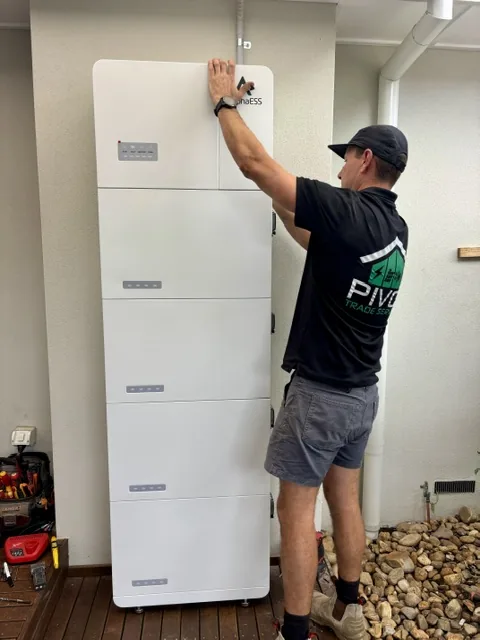
From one of our jobs
Stacking the modules on a home battery install
Photographed on site in Melbourne’s west. REC 37223.
It is not a reason to avoid storage. It is a reason to sequence the job properly. On plenty of Belmont homes the board work is this year and the battery is next, and we would rather set that out at quote stage than find it behind the cover on install day.
Ceramic fuses and what has to happen first
Postwar stock at this scale means original boards are common, and a fair number of Belmont homes still have ceramic fuses rather than circuit breakers behind the door. A battery cannot be connected to a board like that. It is not a preference or an upsell, it is where the installation stops.
A battery also adds circuits and normally a backup sub-board, so even a board with breakers needs spare ways available. Upgrades run $800 to $3,500 or more depending on the supply arrangement and what is found. Priced first, it is a decision. Found later, it is a problem.
Ceramic fuses are a hard stop
A battery will not be connected to a fuse board. The upgrade comes first in both the sequence and the budget.
Spare ways for backup
A backup sub-board needs somewhere to land, and 1950s and 60s boards rarely have room left.
Priced as its own line
Board work is quoted separately at $800 to $3,500 or more so you can see what belongs to the battery and what does not.
Mounting height near the Barwon floodplain
Belmont Common sits on the Barwon floodplain and it has flooded before, most notably in 1952 and again in 1995. On the low-lying streets near the river that is a genuine input into where a battery goes and how high it is mounted, not a hypothetical.
For those addresses we favour a wall-mounted unit at height over a floor-standing one at ground level, keep the inverter and isolators up rather than down, and think about where water would go before deciding what looks tidiest. It costs nothing at design stage and it is impossible to fix afterwards.
Height over tidiness
On the streets near the Common, equipment goes up the wall rather than at floor level.
It has happened twice
The 1952 and 1995 floods are the reason this is a design input rather than a precaution.
Not every Belmont street
The higher parts of the suburb toward Highton do not carry this constraint, so it is assessed by address.
Narrow side access and where the battery lands
Belmont subdivisions are roughly 550 to 750 square metres on 15 to 18 metre frontages with a driveway down one boundary. That means there is usually side access, but it is narrow, and the garage or carport at the end of it is normally the right home for the battery.
A garage position solves temperature, weather and UV in one decision, which matters more than people expect. A unit that spends every February afternoon at 45 degrees will not deliver the cycle life printed on its warranty certificate, and heat is the quietest way to lose value on a battery.
Garage or carport first
The driveway down one boundary usually ends somewhere suitable, which is the simplest good answer.
Heat shortens life
A west-facing external wall in a Geelong February is a poor position for anything with cooling vents.
Narrow but present
Side access here is tight rather than absent, so cable routing is manageable and the run is usually short.
Sizing against a postwar evening
Capacity comes from what you use between roughly 5pm and midnight. Belmont households are often long-term residents in homes that have been progressively electrified, so the evening load is usually reverse cycle heating, cooking and hot water rather than a large ducted system.
That commonly lands at 10kWh to 13kWh usable. The limit is what the array can actually charge. Concrete tile hips at a shallow 20 to 25 degrees with mixed street orientation give a good share of usable north and west planes here, so the surplus is generally there, provided the array was not sized down to suit an old board.
Measure, do not estimate
Twelve months of interval data from your retailer sizes a battery better than any rule of thumb.
Mixed orientation helps
Belmont street layouts give a decent share of north and west planes, which supports a genuine daily surplus.
Old board, small array
If your array was limited by an old board years ago, fixing the board may be worth more than adding storage first.
Backup, the federal discount and Powercor
A standard grid-connected battery shuts down in an outage. Backup needs backup-capable equipment, a gateway and a sub-board carrying nominated circuits, usually the fridge, some lights, the internet and a few power points. On a Belmont home that sub-board is often installed as part of the switchboard upgrade, which is the efficient way to do it.
On price, a 10kWh battery is $8,000 to $12,000 before rebates and $5,500 to $9,500 after the federal Cheaper Home Batteries discount, roughly 30 percent at about $250 per usable kilowatt hour from 1 May 2026, tapering above 14kWh. Belmont is Powercor, so the inverter application is the same one we lodge weekly in the western suburbs of Melbourne, and we lodge it before install day.
Combine board and backup
Doing the backup sub-board during the switchboard upgrade avoids paying for the same access twice.
VPP capable to qualify
The federal discount requires a battery capable of joining a virtual power plant, though enrolling is your choice.
Scheduled from Altona
Belmont is about 65km from us, so work is booked into blocks and we nominate the week rather than the hour.
On the ground
Belmont battery notes
- Postwar 1950s to 1970s stock means original boards are common and some still have ceramic fuses. A battery cannot be connected to one, so the upgrade sits ahead of it.
- Belmont Common is on the Barwon floodplain and flooded in 1952 and again in 1995, so on the low-lying streets near the river equipment mounting height is a design decision.
- Blocks of 550 to 750 square metres with a driveway down one boundary usually end at a garage or carport, which is the best battery position for heat and weather.
- These houses were wired for a fraction of a modern load, so spare capacity at the board is usually the constraint before anything is added to it.
Licensed and accredited work by a local team. Read about Pivot Trade Services or see recent jobs across the western suburbs.
Answers
Belmont questions
Not until the board is replaced. A battery cannot be connected to a ceramic fuse board, and the installation adds circuits plus normally a backup sub-board on top of that. A switchboard upgrade runs $800 to $3,500 or more depending on the supply arrangement. We price it separately so the sequence and the cost are both clear.
On the low-lying streets near the river, yes. The Common sits on the Barwon floodplain and flooded in 1952 and again in 1995. For those addresses we favour a wall-mounted unit at height rather than a floor-standing one, and we keep the inverter and isolators up. It costs nothing to plan and cannot be fixed later.
The garage or carport at the end of the driveway. Blocks here are 550 to 750 square metres with access down one boundary, so the run is short and the position solves heat, weather and UV together. That matters, because a unit baking on a west wall each February will not deliver its rated cycle life.
Commonly 10kWh to 13kWh usable, set by evening consumption between 5pm and midnight rather than by roof size. Belmont roofs are shallow tile hips with mixed street orientation, which gives a decent share of north and west planes and a real daily surplus, provided the array was not sized down years ago to suit an old board.
On most Belmont homes the board comes first, because everything else lands on it. If the array was limited years ago by board capacity, expanding it after the upgrade is often worth more than storage. A battery without a surplus to charge from is the slowest of the three to repay. We set out the order in writing.
No. We work Belmont from Altona, about 65km away, and we book Geelong jobs in scheduled blocks rather than promising same-day attendance. Powercor runs the network in both places, so the battery connection application is one we lodge every week. For planned storage work, the distance changes nothing except the calendar.
Other work we do in Belmont
- Electrician in BelmontPostwar wiring carrying three generations of appliances
- Solar installation in BelmontGood roofs, tired switchboards
- EV charger in BelmontOn this housing stock, the charger is usually a board job first
- Split system in BelmontPostwar wiring, modern load, one dedicated circuit at a time
- Heat pump hot water in BelmontBoard first, then the changeover
Get a Belmont quote
Tell us the address and what you need. We quote Belmont 3216 and the surrounding western suburbs in writing, with no obligation.
- Free
- On-site quotes
- Fixed
- Written pricing
- 100%
- Workmanship guarantee
- 5.0★
- 69 Google reviews