
Board first, then the changeover
Heat Pump Hot Water Systems in Belmont, Geelong
Belmont is mostly 1950s to 1970s postwar housing that has had three generations of appliances added to wiring designed for one. On a hot water changeover that shows up in two places: what is behind the meter box door, and whether the old tank is sitting on a controlled load circuit that was installed when the house was built.
- Belmont 3216
- Powercor network
- REC 37223
The short answer
Heat pump hot water in Belmont 3216 usually starts with the switchboard. The suburb is predominantly 1950s to 1970s weatherboard and brick veneer, so original boards with ceramic fuses are common and many houses still run an electric storage tank on off peak controlled load. Powercor is the distributor. The system is $3,000 to $4,500 supplied and installed before incentives, plus $800 to $3,500 where the board has to be replaced first. Streets near Belmont Common sit on the Barwon floodplain.
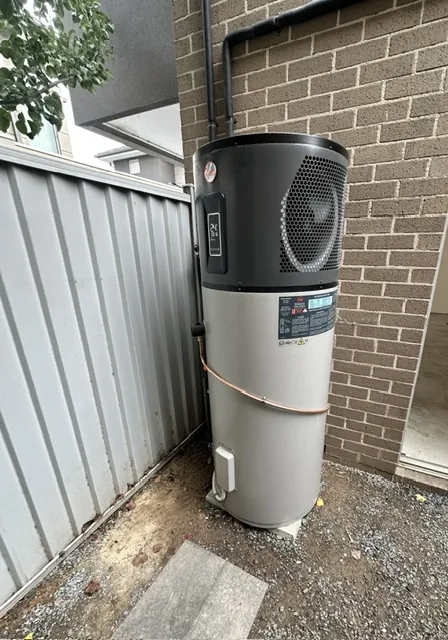
From one of our jobs
Heat pumps sit outside, in the same spot the old gas unit had
Photographed on site in Melbourne’s west. REC 37223.
Neither is a problem, but both change the shape of the job. A heat pump needs its own dedicated circuit and its own isolator, and a rewireable ceramic fuse board cannot provide either compliantly. We check what the board can actually carry before quoting anything that adds load to it, and we put the board on its own line so you can see what is hot water and what is house.
Ceramic fuses and what the board can carry
Postwar stock at this scale means original boards are common, and a fair number still have ceramic fuses rather than breakers behind the door. Those boards have no residual current protection and no spare ways, so there is nowhere for a dedicated hot water circuit to go and nothing protecting it if there were.
Replacement runs $800 to $3,500 depending on whether the meter panel and consumer mains also need attention. That is not a heat pump cost, it is a house cost that the heat pump has surfaced, and we quote it that way. The 1950s and 60s houses here were wired for a fraction of the current load, so if reverse cycle heating or an EV charger is also on the horizon it is worth sizing the board for all of it once.
Ceramic fuse boards
Still common in unrenovated Belmont houses. No residual current protection and no spare ways means the board comes first.
$800 to $3,500
Driven by the meter panel and consumer mains rather than the hot water system. Quoted as its own line.
Size it once
If heating and a charger are coming too, the board work is cheaper done as one job than as three visits.
Off peak controlled load and the changeover it triggers
A large number of Belmont houses still have the original electric storage tank wired to a controlled load tariff, heating overnight at a lower rate on a separately metered circuit. That arrangement made sense when the appliance was a resistance element and there were no panels on the roof. It makes considerably less sense for a heat pump.
Heating overnight means running the compressor in the coldest air of the day, which is when a heat pump is least efficient, and Geelong nights run cooler and drier than Melbourne. If there is solar on the roof it also means exporting your own generation for a few cents while buying overnight power. Moving the system onto a normal circuit with a daytime timer is usually the better arrangement, and it is a metering conversation with your retailer as well as an electrical one. Powercor runs the network here and in the western suburbs of Melbourne, so that process is one we already handle regularly.
Controlled load is separately metered
Moving off it is a retailer and metering change, not just a rewire. Better done once, as part of the changeover.
Cold air costs efficiency
Overnight heating in Geelong air makes the compressor work harder for the same tank of hot water.
Daytime timer instead
Warmest part of the day, and it uses solar you would otherwise export. Set at commissioning.
Equipment height on the floodplain streets
Belmont Common sits on the Barwon floodplain and has flooded before, most notably in 1952 and again in 1995. On the low-lying streets near the river that is a real design input rather than a historical note, because a heat pump sits outside at ground level with an isolator, a condensate drain and electrical connections attached to it.
On those streets we mount the isolator and any accessible connections higher than we otherwise would, set the unit on a raised base rather than straight onto pavers, and make sure the condensate drain runs away from the slab rather than pooling against it. It costs very little at installation and it is not something you can retrofit sensibly after water has been through.
Raised base
On the low streets near the Common we set the unit above ground level rather than flat on pavers.
Isolator height
Mounted higher on floodplain properties. A small decision at install, an expensive one to fix afterwards.
Drainage direction
Condensate runs away from the slab. On flat river land that takes a moment of planning rather than a guess.
Where it goes on a postwar Belmont block
Belmont subdivisions run roughly 550 to 750 square metres on 15 to 18 metre frontages with a driveway down one boundary, so side access is usually there but narrow. That is a better starting point than the inner suburbs and a worse one than Grovedale. The old tank position on the side of the house is often workable, but the heat pump is bulkier than what it replaces and it needs to breathe.
The decision comes down to airflow, noise direction and drainage. If the original tank sat directly under a bedroom window, the rear corner of the house is worth the extra pipe and cable, because it removes the complaint before it happens. We leave service clearance too, so that getting a tank out again in a decade is not harder than it needs to be.
Original tank position
Usually workable on a postwar Belmont block. Existing plumbing, existing drainage, shortest run to the bathroom.
Rear corner alternative
Worth the extra run where the old tank sat under a bedroom window, on either side of the fence.
Service clearance
Leave room to remove a full tank in ten years. Fencing a unit in tightly makes the next replacement dearer.
What you pay, and when the 2027 rule matters
Supplied and installed the system is $3,000 to $4,500 before incentives. Solar Homes contributes up to $1,000, or up to $1,400 for a locally made product, under a $150,000 combined household income cap from 1 July 2026. Victorian Energy Upgrades discounts the invoice directly with no income test, on a property at least two years old and with a $200 including GST minimum contribution. Federal STCs are worth roughly $300 to $600. Most households pay a few hundred dollars up to about $1,500, with any board work on top.
If what you have is a gas storage unit rather than an electric tank, the 1 March 2027 standard is worth knowing about. From that date, an existing home replacing an end of life gas hot water system must install an efficient electric system instead. It applies at replacement, not as a forced early upgrade, so a working gas unit can stay. The useful move is to get the quote and the board assessment done now, while you still have hot water.
Board is extra
The $3,000 to $4,500 is the hot water system. A ceramic fuse board replacement sits on top at $800 to $3,500.
1 March 2027
Applies when an end of life gas system is replaced, not on a fixed deadline for working equipment.
Quote before it fails
A Belmont house with an old board is a two part job. Working that out in advance beats working it out with no hot water.
On the ground
Belmont specifics
- Postwar 1950s to 1970s stock at this scale means original boards are common and a fair number still have ceramic fuses rather than breakers behind the door
- Many houses still run the original electric storage tank on off peak controlled load, which is separately metered and has to be dealt with as part of the changeover
- Belmont Common sits on the Barwon floodplain and flooded in 1952 and again in 1995, so equipment height and drainage matter on the low-lying streets near the river
- Subdivisions of 550 to 750 square metres on 15 to 18 metre frontages give side access down one boundary, usually workable but narrower than the 1970s suburbs further south
Licensed and accredited work by a local team. Read about Pivot Trade Services or see recent jobs across the western suburbs.
Answers
Belmont questions
No, it changes the scope. A heat pump needs a dedicated circuit and its own isolator, and a rewireable fuse board cannot provide either compliantly. Replacement runs $800 to $3,500 depending on the meter panel and consumer mains. We quote it as a separate line so you can see what belongs to the hot water job and what belongs to the house.
You can, but it is rarely the best outcome now. Controlled load heats overnight, which runs the compressor in the coldest air of the day, and Geelong nights are cooler and drier than Melbourne. With solar it also means exporting your generation for a few cents while buying overnight power. A daytime timer on a normal circuit usually wins, and it involves a metering change.
On the low streets near the river, yes. The Common sits on the Barwon floodplain and flooded in 1952 and again in 1995. We set the unit on a raised base rather than flat on pavers, mount the isolator higher than standard and run the condensate away from the slab. It costs little at installation and cannot be sensibly retrofitted afterwards.
Often, but not always. Belmont driveways down one boundary give side access, and the original tank position has the plumbing and drainage already. The heat pump is bulkier than what it replaces and needs clearance on the intake and discharge faces. Where the old tank sat under a bedroom window, the rear corner is worth the extra pipe and cable.
If the board needs replacing anyway, yes. The 1950s and 60s houses here were wired for a fraction of the current load, so a board sized for hot water alone may not carry heating and a car later. Doing the board once, sized for the whole plan, is cheaper than three separate visits and three separate making good jobs.
No. Belmont is about 65km from our Altona base and we book Geelong work in scheduled blocks, nominating the week rather than the hour. We do not offer same-day attendance at that distance and would not claim to. For a planned changeover that costs nothing, because the unit is ordered before we travel and the job is done in one visit.
Other work we do in Belmont
- Electrician in BelmontPostwar wiring carrying three generations of appliances
- Solar installation in BelmontGood roofs, tired switchboards
- Home battery in BelmontBoard work first, storage second
- EV charger in BelmontOn this housing stock, the charger is usually a board job first
- Split system in BelmontPostwar wiring, modern load, one dedicated circuit at a time
Get a Belmont quote
Tell us the address and what you need. We quote Belmont 3216 and the surrounding western suburbs in writing, with no obligation.
- Free
- On-site quotes
- Fixed
- Written pricing
- 100%
- Workmanship guarantee
- 5.0★
- 69 Google reviews