
Get the board and the supply right, then everything connects
Heat Pump Hot Water Systems in Braybrook
Braybrook is a renovation and redevelopment suburb. Original post-war homes and public housing sit alongside a heavy wave of new townhouse development, and blocks around Ashley Street and toward the Maribyrnong are being subdivided into multi-unit sites at a steady rate. Our approach here is staged: get the board and the supply right first, then everything else has somewhere to connect.
- Braybrook 3019
- Jemena network
- REC 37223
The short answer
Heat pump hot water in Braybrook costs $3,000 to $4,500 supplied and installed before incentives and uses roughly one third of the electricity of a conventional electric storage tank. Solar Homes contributes up to $1,000, or up to $1,400 for a locally made product, Victorian Energy Upgrades applies a discount directly to the invoice, and federal STCs are worth roughly $300 to $600. Most Braybrook households pay a few hundred dollars up to about $1,500.
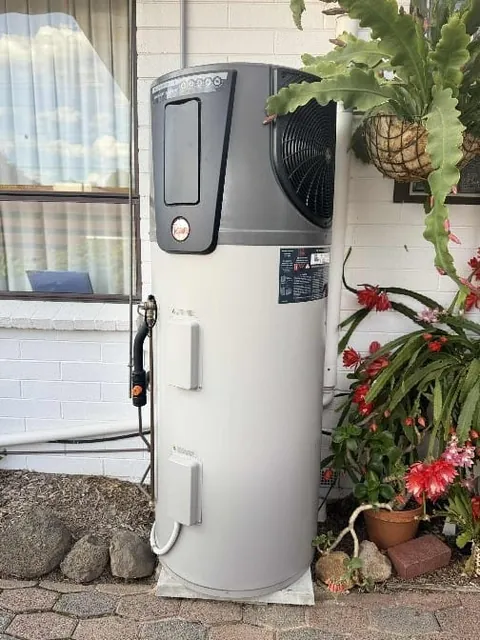
From one of our jobs
Same footprint, roughly a third of the running cost
Photographed on site in Melbourne’s west. REC 37223.
Hot water is usually the appliance that triggers the conversation, because a failed tank is urgent in a way a dated board is not. But established homes here are among the most likely in the west to still lack safety switches entirely, and that has to be dealt with before a new circuit goes anywhere.
Homes with no safety switches at all
This is the finding that sets Braybrook apart. Established homes here are among the most likely in the western suburbs to have no RCD protection anywhere on the installation. Not a partial retrofit, not RCDs on some circuits, none at all.
A heat pump needs a dedicated, properly protected circuit and an accessible isolator at the unit. Adding that to an unprotected board without addressing the rest is a half measure. We quote the board work as its own line, explain plainly what is missing, and let you decide with the numbers in front of you rather than a lecture.
No RCD protection
Common in established Braybrook homes. The new hot water circuit must be protected regardless of what the rest of the board does.
Staged approach
Board and supply first, then hot water, then anything else. Doing it in that order avoids terminating the same circuits twice.
Rental and investor stock
Where the property is tenanted, safety switch compliance is a landlord obligation worth resolving at the same time.
Temporary supplies
Renovation work is constant here, so staged rewires and temporary arrangements come up regularly and need planning.
New multi-unit developments
New townhouse sites need separate supplies, correctly positioned meter panels and individual boards. Getting that layout right at the start determines how easy or hard every subsequent appliance is, including the hot water.
Where we are involved early, we position the meter panel and the boards so that the hot water plant, the air conditioning condenser and any future EV charger all have sensible, short cable routes. Where we come in after the fact, we work with what is there, and the difference in cost is entirely down to that early planning.
Placement on a subdivided or compact lot
Original blocks under active subdivision leave very little clear ground per dwelling once driveways, setbacks and outdoor living areas are accounted for. The narrow side corridor is the obvious place for plant and usually the worst one, because airflow is restricted and compressor noise reflects between two parallel walls.
We look for a rear or corner position with clear air on three sides, keep the fan discharge away from ground floor bedroom windows on both sides of the boundary, and fit anti vibration mounts as standard. On very tight sites a split configuration lets the tank and the compressor sit in different places, which sometimes solves an otherwise impossible layout.
What the running cost change actually looks like
A conventional electric storage tank uses an element, and an element cannot return more heat than the electricity you put into it. A heat pump moves heat out of the outside air into the tank and does the same job on roughly a third of the electricity. That is the entire proposition and it applies whether the house is a 1950s original or a new townhouse.
On top of that, the heating cycle can be moved into the middle of the day. That is more efficient because the air is warmer, and on a property with solar it converts generation that would otherwise be exported for a few cents into hot water you use that evening. It is a setting, not extra hardware, and we configure it before we leave.
For a household that has been running an old element tank on an overnight controlled load tariff, those two changes together are usually the largest single reduction in a Braybrook power bill available without touching the heating or the roof. We walk whoever runs the house through the controller before we pack up.
On the ground
Braybrook specifics
- Established homes here are among the most likely in the west to still have no safety switch protection at all
- New multi-unit developments need separate supplies, correctly positioned meter panels and individual boards, and early planning makes every later appliance cheaper
- Constant renovation activity means temporary supplies and staged rewires come up regularly
- Subdivided lots leave little clear ground, so a rear or corner position with clear airflow usually beats the narrow side corridor
- Rental and investor stock is common, and safety switch compliance is worth resolving at the same time as the hot water
Licensed and accredited work by a local team. Read about Pivot Trade Services or see recent jobs across the western suburbs.
Answers
Braybrook questions
Yes, but the new circuit has to be properly protected regardless, so the board work forms part of the job. Established homes here are among the most likely in the west to have no RCD protection anywhere. We quote it as its own line with a plain explanation of what is missing, so you can decide with real numbers.
At the point the meter panel and boards are laid out, not after. Getting supply positions right at the start means the hot water plant, the air conditioning condenser and any future EV charger all get short, sensible cable routes. Retrofitting around a poorly placed meter panel is where the avoidable cost lives.
Usually a rear or corner position with clear air on three sides. The narrow side corridor is the obvious spot and normally the worst, because airflow is restricted and noise reflects between parallel walls into the neighbouring dwelling. On very tight sites a split configuration lets the tank and compressor sit separately, which often solves it.
It changes who needs to be involved and it raises the safety switch question, which is a landlord obligation. Practically, it also means access arrangements and notice. We coordinate that rather than turning up and hoping, and we provide the Certificate of Electrical Safety on completion for your records.
The system is $3,000 to $4,500 supplied and installed before incentives. Solar Homes contributes up to $1,000, or up to $1,400 for a locally made product, Victorian Energy Upgrades discounts the invoice with a minimum customer contribution of $200 including GST, and federal STCs are worth roughly $300 to $600. Most households pay a few hundred dollars up to about $1,500.
Other work we do in Braybrook
- Electrician in BraybrookRenovation and redevelopment work, done in the right order
- Solar installation in BraybrookGet the board right, then the roof
- Home battery in BraybrookThe board decides the timeline
- EV charger in BraybrookGet the board and the supply right, then everything else connects
- Split system in BraybrookRentals, renovations and townhouses, staged properly
Get a Braybrook quote
Tell us the address and what you need. We quote Braybrook 3019 and the surrounding western suburbs in writing, with no obligation.
- Free
- On-site quotes
- Fixed
- Written pricing
- 100%
- Workmanship guarantee
- 5.0★
- 69 Google reviews