
Get the board right, then the roof
Solar Panel Installation in Braybrook
Braybrook is a renovation and redevelopment suburb, and that shapes how solar gets done here. Established homes are among the most likely in the west to still have no safety switches at all, and new townhouse sites are going up on original blocks at a steady rate.
- Braybrook 3019
- Jemena network
- REC 37223
The short answer
Solar installation in Braybrook often starts at the switchboard rather than the roof. Established homes here are among the most likely in Melbourne’s west to still lack safety switches entirely, and a solar circuit cannot be added compliantly until that is fixed, at $800 to $3,500 or more. Braybrook is a Jemena address for pre-approval and export limits. New townhouse developments have compact roofs with shared boundaries, so realistic per-dwelling systems are commonly 3kW to 5kW.
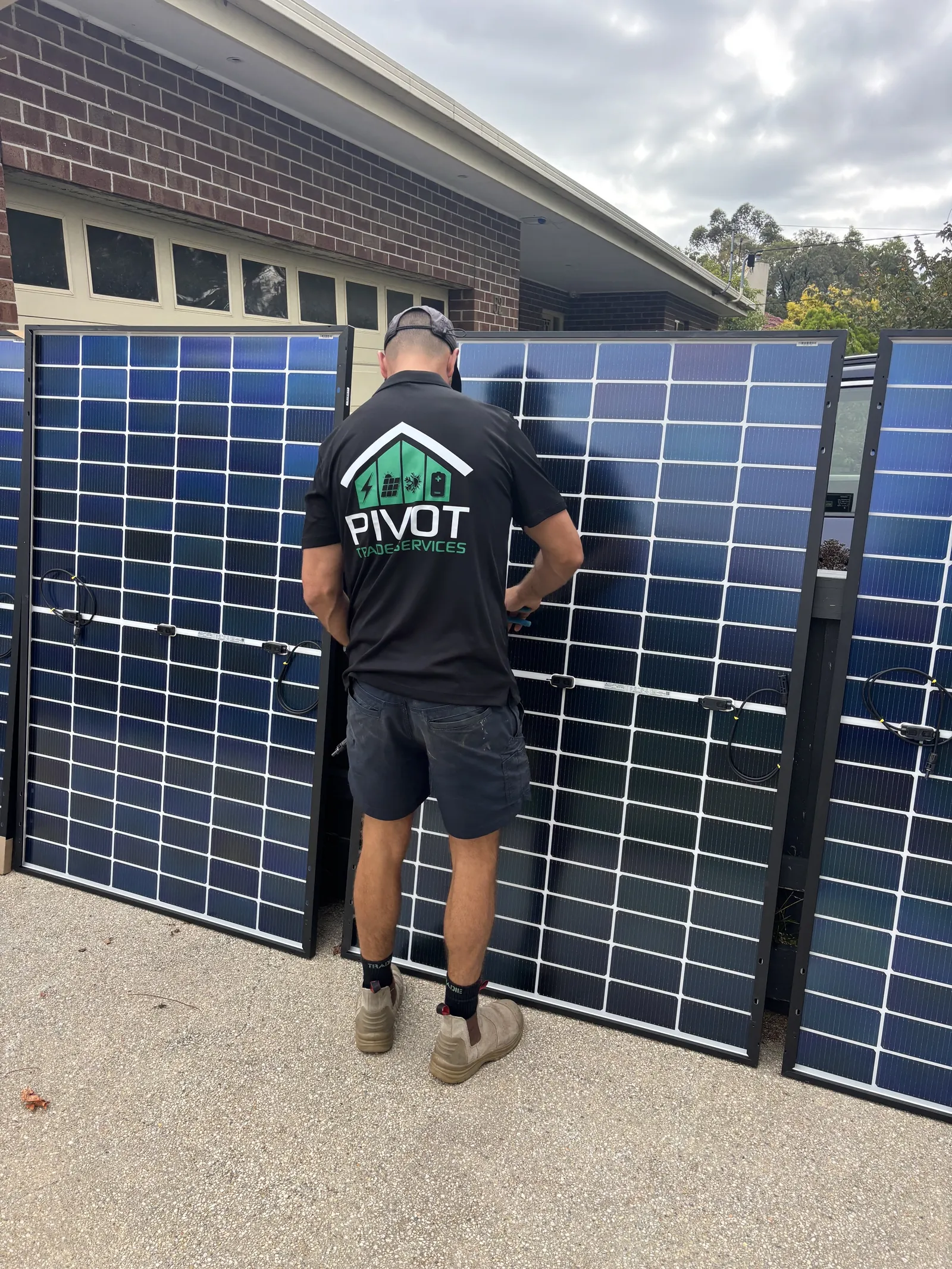
From one of our jobs
Dan prepping panels before they go up on the roof
Photographed on site in Melbourne’s west. REC 37223.
Both situations point the same way: get the supply and the board right first, then everything else has somewhere compliant to connect. Doing it in that order is cheaper than discovering it halfway through an install.
Safety switches come before panels
A meaningful proportion of established Braybrook homes still have no RCD protection at all. That is not a solar problem specifically, it is a general safety gap, and it becomes a solar problem because AS/NZS 3000 sets requirements that must be met when new work is carried out.
Practically, that means the board upgrade is part of the solar project rather than a separate consideration. It runs $800 to $3,500 or more depending on the existing arrangement and what is behind the cover. The upside is that once done, the house is ready for a battery, an EV charger, a heat pump hot water service or anything else you add over the next decade.
Older roofs versus new townhouse roofs
The original post-war stock gives broad tiled roofs with usable northern faces, and 6.6kW is achievable on plenty of them. Tile age is the usual caveat, with brittle older tiles needing spares on site.
The new townhouse developments are the opposite: compact Colorbond roofs with shared boundaries, often double-storey, with neighbours close enough to shade part of the array at either end of the day. Realistic per-dwelling sizes are commonly 3kW to 5kW, and that should be stated at quote stage rather than revised later.
Shared boundary shading
Double-storey townhouses built close together shade each other morning and afternoon. It has to be modelled per dwelling.
Individual supplies
Each townhouse needs its own supply, meter and board, and its solar system connects to its own, not common property.
Tile spares on older roofs
Brittle post-war tiles will break during install. Allowing for replacements is planning, not a variation.
Staged work on a live renovation
Renovation work is constant in Braybrook, and that raises questions solar quotes elsewhere never touch: temporary supplies, staged rewires, and whether the array should go on before or after the extension that is planned for next year.
Our preference is straightforward. If a roof is going to change, put the array on afterwards. If the board is going to be relocated, do that first. Paying to remove and reinstall an array because the sequence was wrong is one of the more avoidable costs in this trade.
Jemena approval and 2026 pricing
Braybrook is a Jemena address. Jemena handles pre-approval, decides whether the connection is accepted and applies any export limit based on capacity in the local network. We lodge it before booking installation.
A quality 6.6kW system is $4,500 to $8,500 before incentives and roughly $3,000 to $6,000 after federal STCs worth $2,000 to $3,000. Eligible households can add up to $1,400 through Solar Victoria Solar Homes, with a combined household income cap of $150,000 from 1 July 2026. STCs are discounted at point of sale and taper annually until the scheme ends in 2030.
On the ground
Braybrook specifics
- Established homes here are among the most likely in the west to have no safety switches at all. That has to be resolved before a solar circuit can be connected compliantly.
- New multi-unit developments need separate supplies, correctly positioned meter panels and individual boards. Which meter the solar connects to is not a detail, it decides who benefits.
- Ongoing renovation work makes sequencing important. If the roof or the board is changing, the array should follow rather than precede that work.
- Double-storey townhouses on shared boundaries shade each other at either end of the day, so per-dwelling shading has to be modelled rather than assumed uniform across a development.
Licensed and accredited work by a local team. Read about Pivot Trade Services or see recent jobs across the western suburbs.
Answers
Braybrook questions
Because a significant proportion of established Braybrook homes still have no RCD protection, and AS/NZS 3000 sets requirements that must be met when new electrical work is carried out. A solar circuit is new work. Where the board needs upgrading it runs $800 to $3,500 or more, and it is inspected and priced before you commit.
It depends what is changing. If the roof is being altered or extended, wait, because removing and reinstalling an array is a genuine cost with no benefit. If only the interior is changing, install now and gain a year of savings. If the switchboard is being relocated, do that first so the solar connects to its final position.
Commonly 3kW to 5kW. Compact Colorbond roofs, double-storey neighbours on shared boundaries and limited unbroken plane length all reduce usable area. That is still a sensible system for a townhouse household. What matters is that the number is honest before deposit rather than revised after the site visit.
Jemena, along with Sunshine, Sunshine North, Maidstone and the inner-west suburbs. Jemena runs pre-approval and sets any export limit based on local network capacity. The process differs slightly from Powercor, which covers the Altona and Werribee side, so the property address determines which application is lodged.
Yes, and you have removed the most common added cost. With a compliant board and spare ways available, a straightforward install on a post-war Braybrook roof is among the simpler jobs we do. A quality 6.6kW system lands at roughly $3,000 to $6,000 after STCs, with up to $1,400 more through Solar Homes if you are eligible.
Other work we do in Braybrook
- Electrician in BraybrookRenovation and redevelopment work, done in the right order
- Home battery in BraybrookThe board decides the timeline
- EV charger in BraybrookGet the board and the supply right, then everything else connects
- Split system in BraybrookRentals, renovations and townhouses, staged properly
- Heat pump hot water in BraybrookGet the board and the supply right, then everything connects
Get a Braybrook quote
Tell us the address and what you need. We quote Braybrook 3019 and the surrounding western suburbs in writing, with no obligation.
- Free
- On-site quotes
- Fixed
- Written pricing
- 100%
- Workmanship guarantee
- 5.0★
- 69 Google reviews