
A suburb rebuilding itself two units at a time
Heat Pump Hot Water Systems in Sunshine
Sunshine is changing fast, and we work on both sides of that change. There are established post-war family homes around Hampshire Road and the streets off Kororoit Creek Trail still running original boards without safety switches. There are also new two and three unit townhouse developments going up on those same blocks, each needing its own supply, its own meter position and its own board.
- Sunshine 3020
- Jemena network
- REC 37223
The short answer
Heat pump hot water in Sunshine costs $3,000 to $4,500 supplied and installed before incentives and uses roughly one third of the electricity of a conventional electric storage tank. Solar Homes contributes up to $1,000, or up to $1,400 for a locally made product, Victorian Energy Upgrades applies a discount to the invoice, and federal STCs add roughly $300 to $600. Most Sunshine households pay a few hundred dollars up to about $1,500.
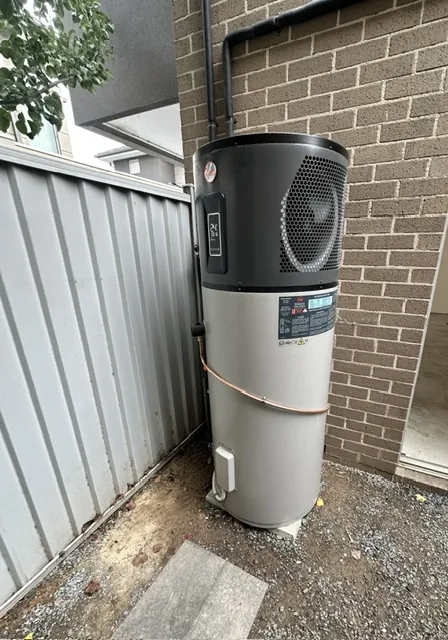
From one of our jobs
Heat pumps sit outside, in the same spot the old gas unit had
Photographed on site in Melbourne’s west. REC 37223.
Hot water sits right at the intersection. On an established home it is usually an ageing tank on a board that cannot compliantly feed a new circuit. On a new unit it is a design decision about where plant goes on a lot that has very little spare ground.
Established post-war homes
The typical established Sunshine home has an electric storage tank or a gas storage unit down the side, and a board that has circuit breakers or, in the un-subdivided stock, sometimes still fuses, with no RCD protection. That board cannot give a heat pump the dedicated protected circuit and accessible isolator it needs.
So the board is part of the conversation whether you wanted it to be or not. We price it separately and plainly. The upside is that once it is done, the house has safety switches on its circuits, capacity for the next appliance, and no repeat of this discussion in two years when the air conditioner or the induction cooktop goes in.
Subdivision changes where the old tank position even is
Subdivision is the defining trend in Sunshine, and it has a practical consequence people do not expect. When a block is split, the side yard where the hot water service sat may end up on the other side of a new boundary, or be reduced to a service corridor that has to stay clear.
On subdivided and newly subdivided sites we work from the current title and the actual setbacks rather than from where the tank used to be. That sounds obvious and it is exactly the thing that gets missed when someone quotes from a photo.
New boundary lines
The original tank position may now sit on the neighbouring lot or inside a required setback. Worth confirming before ordering.
Separate supplies
Each new unit needs its own supply, meter position and board. The hot water circuit follows that arrangement, not the old one.
Shared driveways
Affect delivery and removal of tanks, and sometimes restrict where plant can sit under owners corporation rules.
Reduced ground space
Two or three units on an original block leaves little clear ground. Placement is a design decision, not a default.
New townhouses: limited space, limited roof
Townhouse developments here have limited roof area each, so solar sizing has to be realistic rather than aspirational. A compact Colorbond roof shared between units might support 3 to 5kW, not the 10kW an established Sunshine North block could carry.
That is still useful for hot water. A heat pump is a small, shiftable load, and even a modest array will typically cover an afternoon heating cycle. What it does mean is that we set the timer to the generation you have rather than assuming a big system, and that we think about tank size against a smaller footprint.
Tank size is worth spending a minute on in a townhouse. Roughly, 170 to 220 litres suits one or two people, 250 to 280 litres suits three or four, and 300 litres or more suits five or more. A heat pump reheats more slowly than a gas instantaneous unit, so on a compact site the trade off between the physical footprint of the tank and the capacity you actually need is the real decision, and it is one that is much easier to make with a tape measure on site than from a photo.
Noise between units built close together
New Sunshine townhouses sit close to each other and to the boundary, often with bedrooms on the ground floor facing the narrow gap where plant would naturally go. A compressor in that position is heard by both households.
We orient the fan discharge away from windows, fit anti vibration mounts, and set the heating window to daylight hours as a default. Where a development has owners corporation rules about plant on external walls, we check them before ordering rather than after installing.
On the ground
Sunshine specifics
- Original post-war boards without RCDs are still very common in the un-subdivided housing stock
- Subdivision means the old hot water position may now sit across a new boundary or inside a required setback
- New units need their own supply, meter position and board, and the hot water circuit follows that arrangement
- Townhouse roof area is limited, so solar sizing has to be realistic and the heating timer set to the generation actually available
- Ground floor bedrooms facing narrow side gaps make fan discharge direction the key placement decision in new developments
Licensed and accredited work by a local team. Read about Pivot Trade Services or see recent jobs across the western suburbs.
Answers
Sunshine questions
Not necessarily where the old one was. Subdivision often puts the original tank position across a new boundary or inside a required setback. We work from the current title and actual setbacks rather than from where the tank used to sit, which is exactly the thing that gets missed when a quote is done from a photo.
In the established post-war stock, usually yes. Those boards commonly have no RCD protection and cannot give a heat pump the protected dedicated circuit and accessible isolator it needs. We price it as its own line. The benefit is that it also covers you for the next appliance rather than repeating the discussion in two years.
Usually enough for hot water, yes. Townhouse roof area is limited, so you might be looking at 3 to 5kW rather than a large array. Hot water is a small shiftable load and even a modest system will typically carry an afternoon heating cycle. We set the timer to your actual generation rather than a theoretical figure.
It can if it is placed badly, because these units sit close together with ground floor bedrooms facing the narrow side gaps. We orient the fan discharge away from windows, use anti vibration mounts, and default to a daylight heating window. We also check owners corporation rules about external plant before ordering.
The system is $3,000 to $4,500 supplied and installed before incentives. Solar Homes contributes up to $1,000, or up to $1,400 for a locally made product, Victorian Energy Upgrades applies a discount to the invoice on properties at least two years old, and federal STCs are worth roughly $300 to $600. Most households pay a few hundred dollars up to about $1,500.
Other work we do in Sunshine
- Electrician in SunshinePost-war homes on one side, new units on the other
- Solar installation in SunshineA suburb halfway through rebuilding itself
- Home battery in SunshineCheck the meter before the battery
- EV charger in SunshineA suburb rebuilding itself, two circuits at a time
- Split system in SunshinePost war rooms on one block, townhouse walls on the next
Get a Sunshine quote
Tell us the address and what you need. We quote Sunshine 3020 and the surrounding western suburbs in writing, with no obligation.
- Free
- On-site quotes
- Fixed
- Written pricing
- 100%
- Workmanship guarantee
- 5.0★
- 69 Google reviews