
The suburb where the full stack happens
Home Battery Installation in Point Cook
Point Cook is the suburb where we most often do the full stack: solar already on the roof, a battery going in, and an EV charger that has to share capacity with both. Doing those three as one planned design produces a very different result from bolting them on one at a time.
- Point Cook 3030
- Powercor network
- REC 37223
The short answer
Point Cook is where home batteries most often join an existing solar system and an EV charger, and where the three have to share the switchboard sensibly. Homes here are large, double-storey and modern, with real evening consumption, so 10kWh to 13kWh usable is common. Point Cook is a Powercor address and a battery inverter needs its own Powercor application. A 10kWh battery costs $8,000 to $12,000 installed before rebates and $5,500 to $9,500 after the federal program.
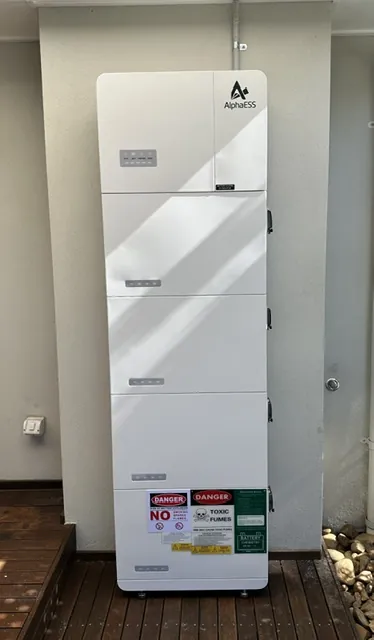
From one of our jobs
A completed home battery cabinet with isolation labelling
Photographed on site in Melbourne’s west. REC 37223.
It is also a suburb with modern switchboards, which is a genuine advantage. The question here is rarely safety and almost always spare capacity, because solar, storage and a charger all want somewhere to connect and the board fills faster than people expect.
Battery and EV charger competing for the same energy
A battery and an EV both want your solar surplus, and if nobody decides the priority the outcome is arbitrary. If the car charges at midday, it takes the energy the battery would have stored. If the car charges at 7pm off the battery, the battery empties and the house imports at 30 to 45 cents later in the night.
The right answer depends on your driving pattern, and it is a configuration decision rather than a hardware one. Load management on the charger, plus charge and discharge windows on the battery, plus a realistic view of when the car is actually at home. We set that up at commissioning and revisit it after the first full billing cycle, because the data usually corrects at least one assumption.
Decide the priority explicitly
Solar to car, solar to battery, or split. Left unconfigured, whichever load is on first simply wins.
Load management protects the main
A charger, a battery inverter and a house on one supply can exceed the main. Dynamic load management prevents that without a supply upgrade.
Charge the car in daylight where possible
Daytime charging uses solar directly at full value and leaves the battery free for the evening peak.
Sizing for a large modern home
Point Cook homes are big, often double storey, with multi-head splits or ducted systems and substantial evening load. Evening consumption between 5pm and midnight here is commonly higher than in the older suburbs closer to the bay, which supports 10kWh to 13kWh of usable capacity.
Above 14kWh the federal rebate tapers, so the marginal kilowatt hour costs more. Unless there is an EV charging in the evening or an unusually high overnight load, that taper is generally the right place to stop. Buying capacity you cannot cycle daily is the fastest way to turn a 7 to 10 year payback into something far longer.
VPPs, and what you are actually signing
VPP offers are more common in Point Cook than most of the west, partly because of the number of batteries already installed. A Virtual Power Plant lets a retailer discharge your battery into the grid during high demand in exchange for payments, credits or an upfront discount.
Before joining, read the terms rather than the headline. How many discharge events per year, whether you can opt out of individual ones, what state of charge is reserved so you still have backup, how long the contract runs, and what happens if you change retailers. We install VPP-capable equipment and configure it for whichever program you choose, and we do not push anyone into one. The federal rebate requires the battery to be VPP-capable, not for you to actually enrol.
Powercor approval and switchboard capacity
Point Cook is Powercor. A battery inverter is a grid-connected inverter under AS/NZS 4777.2, so adding one changes the total inverter capacity at your connection and requires a fresh application. In estates where a high proportion of neighbours already export, that assessment matters more than it does in older suburbs.
Switchboards here are modern and generally compliant, so the work is usually about spare ways and sensible layout rather than replacement. If solar, a battery, a backup sub-board and an EV charger are all going to live on the same board, planning the final arrangement once is far cheaper than reworking it three times over five years.
On the ground
Point Cook battery notes
- Very high EV ownership here means battery and charger priority has to be configured deliberately. Left to default, the two compete for the same solar surplus.
- Modern estate switchboards are compliant but fill quickly once solar, storage, a backup sub-board and a charger are added. Planning the final layout early avoids repeated rework.
- A high density of existing solar in these estates means Powercor assesses added inverter capacity more closely than in suburbs with less installed generation.
- VPP offers circulate widely in Point Cook. The federal rebate requires VPP-capable equipment, not enrolment, so joining is a separate decision made on the contract terms.
Licensed and accredited work by a local team. Read about Pivot Trade Services or see recent jobs across the western suburbs.
Answers
Point Cook questions
It depends when the car is home. If it is parked during the day, charging it directly on solar uses that energy at full value and leaves the battery free for the evening peak. If it is only home at night, the battery should take priority during the day. It is a configuration decision, and we set it at commissioning then review it after a billing cycle.
Usually, with dynamic load management on the charger. That monitors the total draw at the main and reduces charging current when the house demand rises, which prevents overload without paying for a supply upgrade. On three-phase properties there is more headroom. We size and configure this as part of the design rather than hoping the peaks never coincide.
It depends on the terms and on why you bought the battery. Payments improve the return, but you hand over partial control of an asset you own. Check the number of discharge events, whether you can opt out, and what state of charge is reserved so backup still works. If blackout protection was your main reason for buying, a VPP may not suit.
Commonly 10kWh to 13kWh usable. These are large modern homes with substantial evening load, so they can genuinely cycle that most days. Above 14kWh the federal rebate tapers and each extra kilowatt hour costs proportionally more, which is generally the right place to stop unless an EV charges at home in the evening.
Yes. Adding a battery inverter changes the total inverter capacity at your point of connection, so Powercor reassesses it under AS/NZS 4777.2 even where your solar was approved years ago. In estates with high existing solar density that review is more substantive, so we lodge early rather than close to the install date.
Other work we do in Point Cook
- Electrician in Point CookSolar on the roof, a battery going in and a car to charge
- Solar installation in Point CookEstate roofs, EVs and second systems
- EV charger in Point CookWhere the charger has to share the house with solar and a battery
- Split system in Point CookDouble storey estate homes and the upstairs problem
- Heat pump hot water in Point CookAdding one more load to an already busy switchboard
Get a Point Cook quote
Tell us the address and what you need. We quote Point Cook 3030 and the surrounding western suburbs in writing, with no obligation.
- Free
- On-site quotes
- Fixed
- Written pricing
- 100%
- Workmanship guarantee
- 5.0★
- 69 Google reviews