
Where the surplus is genuinely large
Home Battery Installation in Altona Meadows
The Meadows has the best residential solar roof space in the west, and that produces a specific problem worth solving. Large arrays on big unshaded roofs generate more through the middle of the day than the house can use, and since July 2025 that surplus has been worth almost nothing on export.
- Altona Meadows 3028
- Powercor network
- REC 37223
The short answer
Altona Meadows is one of the strongest battery suburbs in Melbourne’s west, because its large unshaded estate roofs support big solar arrays that now export surplus for under 5 cents per kWh. Storing that instead and avoiding 30 to 45 cent evening imports is the whole return. Ducted heating and cooling gives these homes a substantial evening load, so 10kWh to 13kWh usable is common. Altona Meadows is a Powercor address, and a 10kWh battery costs $5,500 to $9,500 after the federal rebate.
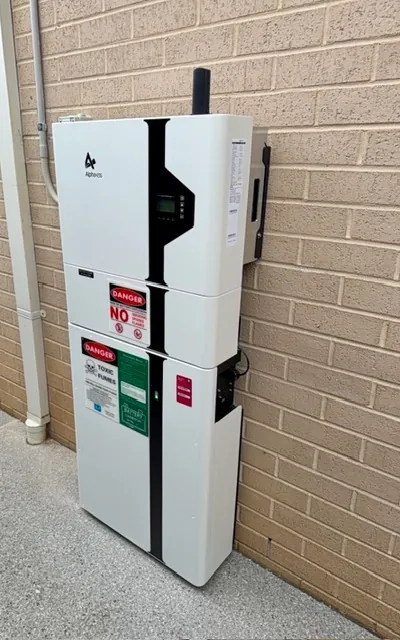
From one of our jobs
A battery stack tucked down the side of the house
Photographed on site in Melbourne’s west. REC 37223.
A battery is the direct answer to that. It is also the suburb where households most often justify going toward the upper end of sensible capacity, because 1980s and 1990s family homes with ducted heating and cooling have an evening load large enough to actually empty one.
A real surplus to store
Battery economics fail when there is nothing spare to charge from. In the Meadows that is rarely the issue. A 6.6kW to 10kW array on a clear northern and western roof produces a genuine midday surplus even in a household that has already shifted its hot water and laundry into daylight.
That means the battery charges fully most days from March through October and near enough to it in winter. A battery that fills and empties daily earns its return. One that half fills, because the array was small or shaded, takes twice as long to pay for itself, which is why this suburb performs better than the inner west on the same equipment.
Sizing against a ducted evening
The correct capacity comes from your evening consumption between roughly 5pm and midnight. In the Meadows that number is often higher than the western suburbs average, because these homes are large, single storey, and heated and cooled by ducted systems rather than a single split.
Ten to thirteen kilowatt hours of usable capacity is a common landing point here. Above 14kWh the federal rebate tapers, so each additional kilowatt hour costs proportionally more, and that is generally where the sensible ceiling sits unless there is an EV charging at home in the evening as well.
Ducted is the swing load
Evening heating and cooling is what a battery in this suburb mostly discharges into. It is worth measuring rather than estimating.
Pre-condition on solar first
Cooling the house on direct solar in the afternoon costs the battery nothing and reduces what it has to carry at 7pm.
Stop at the taper
The rebate reduces above 14kWh usable, so capacity beyond that has to justify itself on cycling alone.
Then look at the EV
If a car charges in the evening, that changes the sizing more than any other single factor in the household.
Siting, distance and switchboards
Meadows homes usually have a proper garage, which makes battery siting simpler than in the inner west. The catch is distance. Wide estate blocks mean the run between the switchboard, the inverter and a rear or detached garage can be long, and cable length is a real cost line on a battery install just as it is on an EV charger.
Boards from the 1980s and 1990s here commonly have breakers but not RCD protection on every final subcircuit. Adding battery circuits and a backup sub-board is the moment that gets resolved, at $800 to $3,500 or more. Doing it as part of the battery job avoids paying for the same access twice.
Backup and Powercor approval
Backup here usually means an essential circuits sub-board: fridge, lights, internet, a few power points and often the gas ducted heater’s fan so the house can still be heated in a winter outage. Running full ducted cooling off a home battery is not realistic for most systems, and we would rather set that expectation before purchase.
Altona Meadows is a Powercor address. Because a battery inverter is a grid-connected inverter under AS/NZS 4777.2, it needs a fresh Powercor application, and on properties with an already-large solar inverter that review can matter. We lodge it before install day rather than after.
On the ground
Altona Meadows battery notes
- This suburb generates a genuine daily solar surplus, which is the single best predictor of whether a battery will pay. Many inner-west homes do not have one.
- Ducted heating and cooling gives Meadows homes an evening load big enough to cycle 10kWh to 13kWh most days, which is higher than the regional average.
- Long runs from switchboard to a rear or detached garage are a real cost variable on battery installs here, exactly as they are on EV chargers.
- Backing up the ducted heater fan, rather than the whole system, is a practical compromise that keeps a Meadows house warm during a winter outage.
Licensed and accredited work by a local team. Read about Pivot Trade Services or see recent jobs across the western suburbs.
Answers
Altona Meadows questions
Sizing comes from evening consumption rather than array size. Measure what you use between 5pm and midnight. In Altona Meadows, with ducted heating and cooling, that commonly supports 10kWh to 13kWh usable. Above 14kWh the federal rebate tapers, so extra capacity costs proportionally more and has to justify itself purely on how often you cycle it.
Realistically, no. Ducted cooling draws far more than most home battery inverters can deliver, and it would empty the battery quickly even if it started. What works is backing up essential circuits, and for gas ducted heating, backing up the fan so the house can still be heated. That is a practical winter outcome rather than a marketing claim.
Because the surplus exists. Meadows roofs are large and unshaded, so arrays here generate a genuine midday excess that currently exports for under 5 cents per kWh. A battery that charges fully and discharges fully most days pays back far faster than one that half fills because the array was limited by a small, shaded inner-west roof.
Often it needs work first. Boards of that era typically have circuit breakers but not RCD protection on every final subcircuit, and a battery install adds circuits plus usually a backup sub-board. Upgrades run $800 to $3,500 or more. Doing it during the battery installation avoids paying separately for access and certification later.
Yes. A battery inverter is a grid-connected inverter under AS/NZS 4777.2, so it changes the total inverter capacity at your point of connection. Powercor assesses that afresh, and on properties with a large existing solar inverter it is worth lodging early. Nothing is energised before that approval is confirmed.
Other work we do in Altona Meadows
- Electrician in Altona MeadowsThe best solar roofs in the west, on boards that need a look
- Solar installation in Altona MeadowsThe best roof space in the west
- EV charger in Altona MeadowsOn these blocks, the tape measure sets the price
- Split system in Altona MeadowsBig floorplans, big glazing, and a bay two streets away
- Heat pump hot water in Altona MeadowsEstate homes with the roof space to run one for free
Get a Altona Meadows quote
Tell us the address and what you need. We quote Altona Meadows 3028 and the surrounding western suburbs in writing, with no obligation.
- Free
- On-site quotes
- Fixed
- Written pricing
- 100%
- Workmanship guarantee
- 5.0★
- 69 Google reviews