
Small homes, careful siting
Home Battery Installation in Seaholme
Seaholme is a two-kilometre run from our workshop and the suburb where we are most careful about where equipment goes. Salt gets into everything here, and a battery is the last thing you want mounted on a wall that takes weather off the bay.
- Seaholme 3018
- Powercor network
- REC 37223
The short answer
Home battery installation in Seaholme is shaped by two things: direct salt exposure, which rules out exposed external walls for a unit with cooling vents, and compact original beachside homes, which limits where a battery can be placed with the required clearances and fire separation. Seaholme is a Powercor address, so the battery inverter needs a Powercor application. Solar arrays here are typically 5kW to 6.6kW, so 8kWh to 10kWh usable is the common sizing, at $5,500 to $9,500 after the federal rebate.
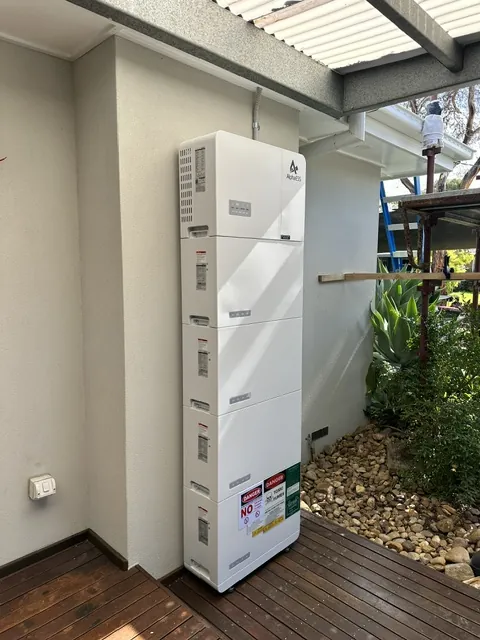
From one of our jobs
Battery modules stack as your storage needs grow
Photographed on site in Melbourne’s west. REC 37223.
The homes are also compact. Original beachside blocks with tight side access do not offer many candidate walls once clearance, fire separation and temperature requirements are applied. On a Seaholme job the siting conversation happens before the equipment conversation, not after.
Salt, ventilation and why the wall matters
Batteries need airflow. That is exactly what makes an exposed coastal wall a poor choice, because the same ventilation that keeps the unit within temperature also lets salt-laden air reach the electronics inside the enclosure.
On Seaholme jobs we look for an internal garage wall, a properly sheltered position under cover, or a location on the leeward side of the building. Where an outdoor position is unavoidable, the enclosure rating, weather protection and mounting hardware all need to reflect direct coastal exposure. It is the same principle we apply to solar isolators here, applied to a much more expensive item.
Leeward and sheltered first
The side of the building away from the prevailing weather off the bay is always the first place we look.
Garages beat external walls
An internal garage wall solves salt, temperature swing and UV in one decision.
Coastal-rated everything else
Isolators, conduit, fixings and enclosures around the battery need the same coastal specification the array does.
Realistic capacity for a Seaholme home
Solar arrays on Seaholme roofs are typically 5kW to 6.6kW because of compact roof planes and foreshore height restrictions. That caps the daily surplus available to charge a battery, and a battery that cannot fill does not pay.
So the honest sizing here is usually 8kWh to 10kWh usable rather than 13kWh. That still covers a normal evening between 5pm and midnight for most households in the suburb, and it matches what the array can realistically deliver on a shoulder-season day rather than on the best day in January.
Old boards, tight access and backup
Some of the oldest surviving switchboards in the area are in unrenovated Seaholme homes. A battery installation adds circuits and normally a backup sub-board, so where the existing board cannot carry that, an upgrade at $800 to $3,500 or more comes first.
Tight side access also affects cable routing between the switchboard, the inverter and the battery position. That route is planned around the building rather than through it, which makes the runs longer than a standard suburban install. It is a genuine line in the quote and one of the main reasons two prices for the same equipment differ.
Powercor, rebates and payback
Seaholme is Powercor, like Altona and Altona Meadows and unlike Williamstown and Newport nearby. Adding a battery inverter requires a fresh Powercor application under AS/NZS 4777.2 even where existing solar was approved years ago, and we lodge it before install.
On money, a 10kWh battery is $8,000 to $12,000 installed before rebates and $5,500 to $9,500 after the federal Cheaper Home Batteries Program, which pays roughly $250 per usable kWh. Payback for a Seaholme household typically sits at the longer end of the 7 to 10 year range, because a smaller array means fewer full cycles. We would rather say that upfront than have you work it out in year four.
On the ground
Seaholme battery notes
- Direct salt exposure makes an internal or sheltered position essential. A ventilated battery enclosure on an exposed bay-facing wall is a design mistake, not a preference.
- Compact roofs mean 5kW to 6.6kW arrays, which caps daily charging surplus. That points to 8kWh to 10kWh usable rather than the larger systems that suit Altona Meadows.
- Some of the oldest boards in the district are here, and a battery cannot be connected to a ceramic-fuse board. The upgrade sits ahead of the battery in the sequence.
- Tight side access means longer cable routes planned around the building, which is a real cost item on a battery install rather than a rounding error.
Licensed and accredited work by a local team. Read about Pivot Trade Services or see recent jobs across the western suburbs.
Answers
Seaholme questions
We avoid it where possible. Batteries need ventilation, and the same airflow that manages temperature also carries salt-laden air to the electronics. An internal garage wall or a sheltered leeward position is preferred. Where outdoors is unavoidable, enclosure rating, weather protection and mounting hardware all need to reflect direct coastal exposure.
It can be, with realistic sizing. A 5kW array produces a smaller daily surplus, so a 13kWh battery would rarely fill and would never repay the extra capacity. An 8kWh to 10kWh system sized to what the array can actually deliver on an ordinary day performs much better. Expect payback toward the longer end of the 7 to 10 year range.
Possibly not. Seaholme has some of the oldest boards in the area, and a battery adds circuits plus normally a backup sub-board. A ceramic-fuse board cannot take that connection at all. Upgrades run $800 to $3,500 or more depending on the supply arrangement, and it is inspected and priced before you commit rather than on install day.
Powercor, the same as Altona and Altona Meadows. Williamstown and Newport nearby are Jemena, so the process changes over a short distance. A battery inverter is a grid-connected inverter under AS/NZS 4777.2, so it needs its own application even where your existing solar was approved separately years ago.
It can be, if specified for backup at install time. A standard grid-connected battery shuts down in an outage for line worker safety. Backup requires backup-capable equipment, a gateway and a sub-board carrying nominated circuits, typically the fridge, lights, internet and a few power points. It adds cost and it has to be decided before installation, not after.
Other work we do in Seaholme
- Electrician in SeaholmeTwo kilometres away, and the strictest suburb we work in for coastal gear
- Solar installation in SeaholmeTwo kilometres from our workshop
- EV charger in SeaholmeTwo kilometres from our workshop, and the saltiest job we do
- Split system in SeaholmeThe most corrosive postcode we install in
- Heat pump hot water in SeaholmeThe suburb where coastal grade hardware is not optional
Get a Seaholme quote
Tell us the address and what you need. We quote Seaholme 3018 and the surrounding western suburbs in writing, with no obligation.
- Free
- On-site quotes
- Fixed
- Written pricing
- 12 mth
- Workmanship guarantee
- 5.0★
- 63 Google reviews