
Check the meter before the battery
Home Battery Installation in Sunshine
Sunshine is changing fast, and the battery question is genuinely different depending on whether you are in an original post-war home or one of the townhouses replacing them. The equipment is the same. The economics and the constraints are not.
- Sunshine 3020
- Jemena network
- REC 37223
The short answer
Home battery installation in Sunshine depends heavily on which side of the suburb’s redevelopment your property sits. Original post-war homes have broad roofs and larger arrays but often boards without RCDs. New townhouses have compact roofs producing 3kW to 5kW, a smaller charging surplus, and separate supplies per dwelling that the battery must connect to correctly. Sunshine is a Jemena address. A 10kWh battery costs $8,000 to $12,000 installed and $5,500 to $9,500 after the federal rebate.
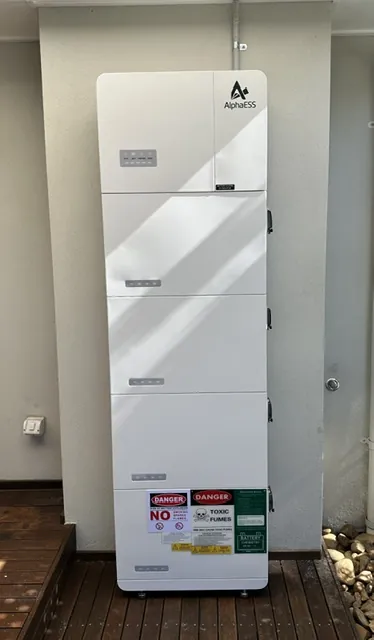
From one of our jobs
A completed home battery cabinet with isolation labelling
Photographed on site in Melbourne’s west. REC 37223.
The one thing worth checking before anything else on a subdivided site is the metering. Each dwelling needs its own supply, meter and board, and a battery has to connect to the right one. Generation and storage landing on the wrong meter is not a theoretical problem, and it is much cheaper to prevent than to correct.
Townhouses: smaller arrays, smaller batteries
A subdivided block splits one original roof into two or three smaller ones, so each townhouse typically supports 3kW to 5kW of solar. That produces a modest daily surplus, which is the ceiling on what a battery can store no matter how large the battery is.
For most Sunshine townhouses that means 8kWh usable is a better fit than 13kWh. Townhouse households also tend to use less than the family home they replaced, so the evening load is smaller too. Both numbers point the same way, and matching the battery to them is what makes the payback land inside the 7 to 10 year range rather than beyond it.
Post-war homes and the RCD question
The un-subdivided stock has broad tiled roofs supporting 6.6kW arrays and a real daily surplus, which makes a 10kWh battery a reasonable proposition. The obstacle is the board. Original post-war boards without RCD protection are still very common here.
A battery adds circuits and normally a backup sub-board, and AS/NZS 3000 requirements apply once new work is done. Where an upgrade is needed it runs $800 to $3,500 or more. On these homes the board work is genuinely part of the project rather than an optional accompaniment to it.
Board first, storage second
The battery inverter connection and backup sub-board both need a compliant board to land on.
One upgrade, several benefits
Once the board is right, an EV charger or heat pump later avoids repeating the same work and access cost.
Certified on completion
All of it is certified under AS/NZS 3000 with a Certificate of Electrical Safety, not just the battery circuits.
Metering on subdivided sites
Subdivision is the defining trend in Sunshine, and it raises questions a standalone house never does. Each dwelling needs its own supply, correctly positioned meter panel and its own board, and any battery or solar has to be connected to that dwelling’s supply rather than to common property.
On older subdivisions it is worth confirming what actually exists rather than what the plan says, because the two are not always the same. We check that before designing, since a battery connected to the wrong supply benefits the wrong party and is expensive to unwind.
Jemena, backup and what it costs
Sunshine is a Jemena address. A battery inverter is a grid-connected inverter under AS/NZS 4777.2, so it changes inverter capacity at your connection and needs its own Jemena application. With heavy development in the area, local network capacity is being committed quickly, so lodging early is worthwhile.
Backup is normally an essential circuits sub-board covering fridge, lights, internet and a few power points. On cost, a 10kWh battery is $8,000 to $12,000 installed and $5,500 to $9,500 after the federal Cheaper Home Batteries Program at roughly $250 per usable kWh, tapering above 14kWh.
On the ground
Sunshine battery notes
- On subdivided sites, confirm which supply and meter serve the dwelling before designing anything. A battery connected to the wrong supply benefits the wrong party.
- Townhouse arrays of 3kW to 5kW cap the charging surplus, which makes around 8kWh usable a better fit than the 13kWh systems that suit larger estate homes.
- Original post-war boards without RCD protection remain very common in the un-subdivided stock, and they cannot carry what a battery installation adds.
- Rapid development means Jemena network capacity in this area is being taken up quickly, so applications are worth lodging early rather than close to install day.
Licensed and accredited work by a local team. Read about Pivot Trade Services or see recent jobs across the western suburbs.
Answers
Sunshine questions
Usually around 8kWh usable. A subdivided block gives each dwelling 3kW to 5kW of solar, which limits the daily surplus available to charge from, and townhouse households generally have a smaller evening load than the family home they replaced. Both point to a smaller battery that cycles fully rather than a larger one that does not.
We confirm the supply and metering arrangement before design, particularly on subdivided sites where what exists is not always what the plan shows. Each dwelling should have its own supply, meter and board, and the battery connects to that. Getting it wrong means the benefit flows to the wrong party and is expensive to correct.
It needs upgrading before a battery can be connected. Original boards without RCD protection are still common in Sunshine, and a battery installation adds circuits plus normally a backup sub-board, which triggers AS/NZS 3000 requirements. Upgrades run $800 to $3,500 or more depending on the supply arrangement and what the inspection finds.
It depends who pays the power bill. If tenants pay, the savings flow to them rather than to you unless that is reflected in rent. Storage also adds an asset you are responsible for maintaining. We would rather work through that arithmetic with you before quoting than after the equipment is on the wall.
Jemena, along with Sunshine North, Braybrook, Maidstone and the inner-west suburbs. A battery inverter changes the inverter capacity at your connection point under AS/NZS 4777.2, so it needs its own application. With heavy local development, capacity is being committed quickly, so we lodge early rather than close to installation.
Other work we do in Sunshine
- Electrician in SunshinePost-war homes on one side, new units on the other
- Solar installation in SunshineA suburb halfway through rebuilding itself
- EV charger in SunshineA suburb rebuilding itself, two circuits at a time
- Split system in SunshinePost war rooms on one block, townhouse walls on the next
- Heat pump hot water in SunshineA suburb rebuilding itself two units at a time
Get a Sunshine quote
Tell us the address and what you need. We quote Sunshine 3020 and the surrounding western suburbs in writing, with no obligation.
- Free
- On-site quotes
- Fixed
- Written pricing
- 100%
- Workmanship guarantee
- 5.0★
- 69 Google reviews