
A suburb halfway through rebuilding itself
Solar Panel Installation in Sunshine
Sunshine is changing faster than almost anywhere in the west. Original post-war blocks are being subdivided into two and three-unit developments, and the solar question is completely different depending on which side of that change your property sits.
- Sunshine 3020
- Jemena network
- REC 37223
The short answer
Solar installation in Sunshine covers two very different property types. Original post-war homes have broad tiled roofs that suit 6.6kW systems but often have boards without RCDs that need upgrading first. New townhouse developments have limited individual roof area, typically supporting 3kW to 5kW each, with separate supplies and meter positions per dwelling. Sunshine is a Jemena address for pre-approval and export limits. A quality 6.6kW system costs $3,000 to $6,000 after federal STCs.
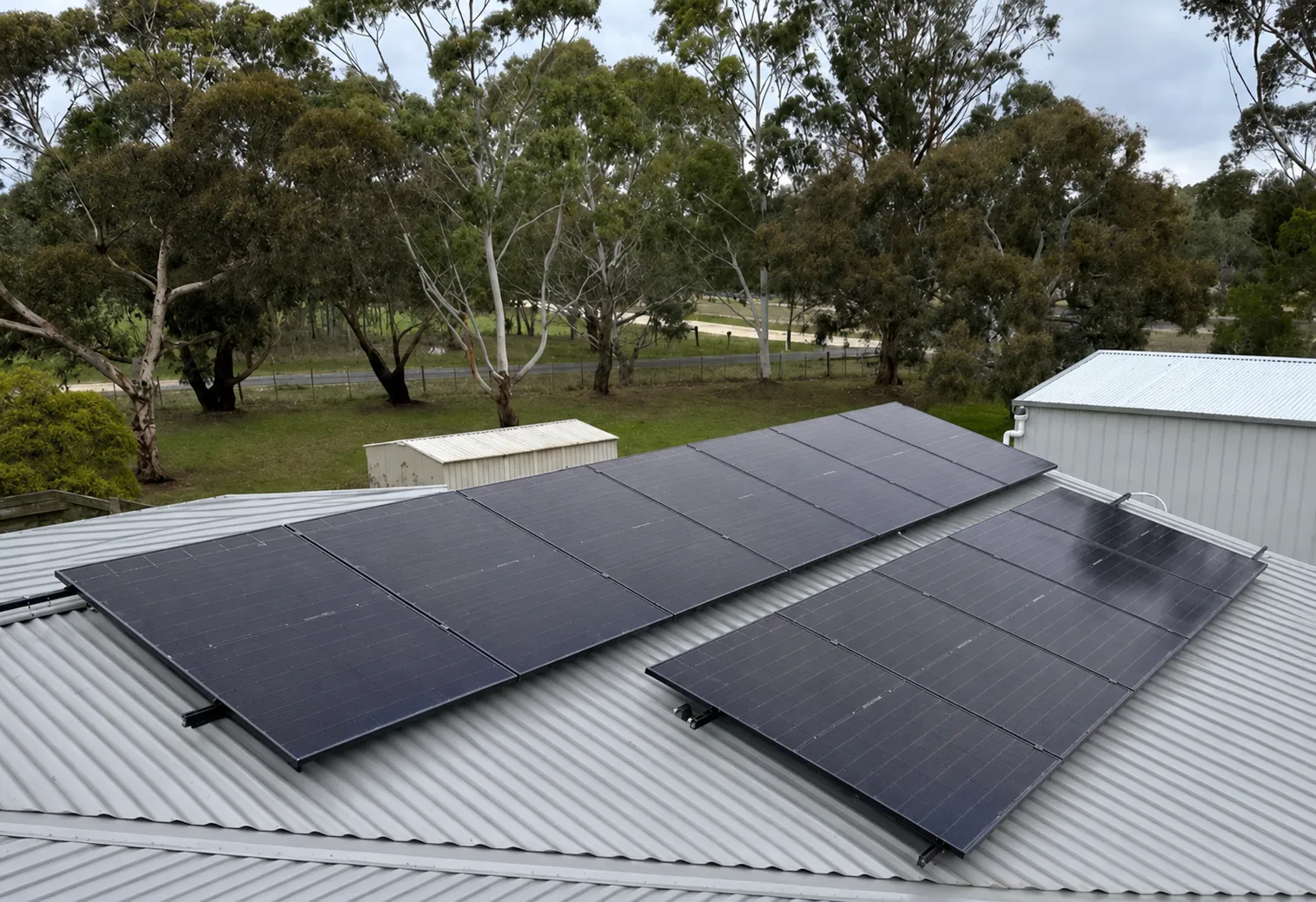
We work on both. Bringing an original home up to standard so it can safely carry a solar circuit is one job. Designing sensible arrays for three townhouses that share a driveway and a boundary is another, and the second one requires the metering and supply arrangement to be right before anything goes on a roof.
Original post-war homes
The un-subdivided stock in Sunshine gives you what post-war housing always gives you: a broad single-storey tiled roof with a clear northern face and enough continuous run for a full 6.6kW array without splitting it awkwardly.
The catch is the board. Original post-war boards without RCDs are still very common here, and a new solar circuit brings requirements under AS/NZS 3000 that those boards cannot meet. Upgrading runs $800 to $3,500 or more. It is the difference between an install that proceeds on the day and one that stops while somebody makes a phone call.
Townhouse developments and realistic sizing
A three-unit townhouse development splits one original roof area into three smaller ones, and each dwelling gets a compact Colorbond roof with limited unbroken plane. Realistic system size per townhouse is often 3kW to 5kW rather than 6.6kW, and pretending otherwise leads to designs that cannot be installed with compliant setbacks.
That is not a bad outcome. Townhouses generally have lower consumption than the family home they replaced, and a 4kW array sized to that consumption performs well. What matters is that the number is honest at quote stage rather than adjusted downward after deposit.
One roof, three dwellings
Each unit gets a fraction of the original roof area. Per-dwelling system sizes are proportionally smaller.
Separate supplies, separate systems
Each dwelling needs its own supply, meter and board, and each solar system connects to its own, not to common property.
Shared boundaries shade
Double-storey townhouses close together shade each other. That is designed around, not discovered afterwards.
Metering, supply and who owns what
Subdivision is the defining trend in Sunshine, and it brings a set of questions that a standalone house never raises. Each new dwelling needs its own supply, its own correctly positioned meter panel and its own board. A solar system has to connect to the right one, or the generation lands on the wrong meter and the household paying for it does not benefit.
On new developments we want the metering and supply arrangement settled before designing the array. On established homes that were subdivided years ago, it is worth confirming what actually exists rather than what the plan says, because the two are not always the same.
Jemena approval and current pricing
Sunshine is a Jemena address. Jemena runs the pre-approval process and applies any export limit based on capacity in the local network. In areas with a lot of recent development that capacity gets committed quickly, so we lodge early and confirm the outcome before installation.
A quality 6.6kW system is $4,500 to $8,500 before incentives and roughly $3,000 to $6,000 after federal STCs worth $2,000 to $3,000. Eligible households can add up to $1,400 through Solar Victoria Solar Homes, subject to a combined household income cap of $150,000 from 1 July 2026. STC value tapers each year until the scheme ends in 2030.
On the ground
Sunshine specifics
- Original post-war boards without RCDs remain very common in the un-subdivided stock. A solar circuit cannot be added compliantly until that is resolved.
- New townhouse developments give each dwelling a fraction of the original roof. Per-unit systems of 3kW to 5kW are the realistic outcome, not 6.6kW each.
- Metering and supply arrangements on subdivided sites have to be confirmed before design, or the generation can end up on the wrong meter.
- Rapid development means local network capacity is being committed quickly, so Jemena export conditions here are worth confirming early rather than assuming.
Licensed and accredited work by a local team. Read about Pivot Trade Services or see recent jobs across the western suburbs.
Answers
Sunshine questions
Usually 3kW to 5kW. A subdivided block gives each dwelling a compact Colorbond roof with limited unbroken plane, and double-storey neighbours on shared boundaries can shade part of it. That still covers daytime consumption for most townhouse households, which is where the return comes from at current Victorian tariffs.
It needs upgrading before a solar circuit can be connected. Original post-war boards without RCD protection are still common in Sunshine, and AS/NZS 3000 sets requirements that those boards cannot meet once new work is done. Upgrades run $800 to $3,500 or more depending on the supply arrangement and what the inspection finds.
Yes, and each system should connect to that dwelling’s own supply, meter and board rather than to common property. Getting the metering arrangement right before the arrays are designed is essential, otherwise generation can land on a meter that does not belong to the household paying for the system. We prefer to see the supply layout first.
Jemena, along with Sunshine North, Braybrook, Maidstone and the inner-west suburbs. Jemena handles pre-approval and sets any export limit based on local network capacity. With heavy development in this area, capacity is being taken up quickly, so we lodge applications early rather than close to install day.
It depends who pays the power bill. If tenants pay, the benefit flows to them rather than the owner, unless the arrangement is reflected in rent. Solar Victoria has run rebate programs specific to rental properties in the past, so eligibility is worth checking. We can confirm what applies before quoting rather than after.
Other work we do in Sunshine
- Electrician in SunshinePost-war homes on one side, new units on the other
- Home battery in SunshineCheck the meter before the battery
- EV charger in SunshineA suburb rebuilding itself, two circuits at a time
- Split system in SunshinePost war rooms on one block, townhouse walls on the next
- Heat pump hot water in SunshineA suburb rebuilding itself two units at a time
Get a Sunshine quote
Tell us the address and what you need. We quote Sunshine 3020 and the surrounding western suburbs in writing, with no obligation.
- Free
- On-site quotes
- Fixed
- Written pricing
- 100%
- Workmanship guarantee
- 5.0★
- 69 Google reviews