
An industrial suburb with houses tucked inside it
Heat Pump Hot Water Systems in North Geelong
North Geelong is the most industrial suburb in the region, a small residential pocket of 1920s to 1960s weatherboard and brick set among 1860s subdivisions and a large proportion of industrial land. That means two genuinely different hot water conversations happen inside one postcode, and the answer for a business on the Federal Mills site is not the answer for a house near the station.
- North Geelong 3215
- Powercor network
- REC 37223
The short answer
Heat pump hot water in North Geelong 3215 splits two ways. The suburb is the most industrial in the region, so a share of the work is three phase commercial hot water on warehouse and business park sites, while the residential pocket is 1920s to 1960s weatherboard and brick on 450 to 650 square metre lots. Powercor is the distributor. Fronting Corio Bay with the port and saleyards alongside means outdoor equipment sees salt and dust together.
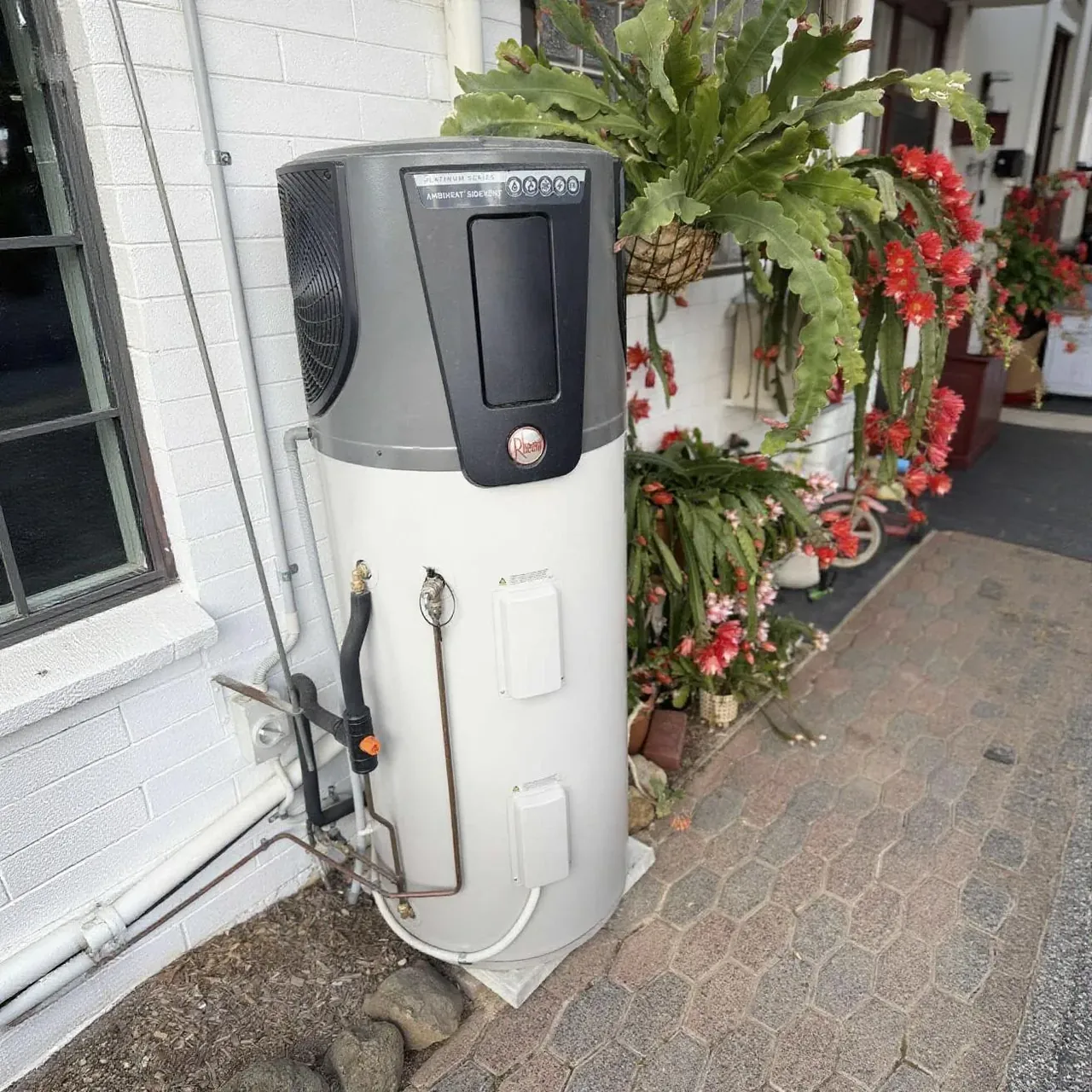
On the commercial side, a large share of the work here is three phase, and the buildings are old enough that distribution predates modern standards. On the residential side, the houses are modest, the lots have workable side setbacks, and the constraint is the board vintage rather than the block. Both jobs share one thing: outdoor equipment here sees salt off Corio Bay and dust off the port and saleyards at the same time.
Commercial hot water on a three phase site
The Federal Mills business park alone supports over a thousand jobs on a restored industrial site, and buildings of that age have distribution that predates modern standards. Commercial hot water is a different design problem to domestic. Demand is concentrated in specific hours, the load may be shared across tenancies, and the switchboard question is about which board has capacity rather than whether the house has a spare way.
Heat pump technology scales to that, but the sizing has to follow real usage rather than a domestic rule of thumb, and the outdoor unit placement has to work around existing plant. We survey what is actually installed, trace which tenancy meter the hot water lands on, and price the circuit work separately from the appliance. A Certificate of Electrical Safety is issued on completion and goes into the building compliance file.
Three phase distribution
Most sites here are three phase, and older industrial buildings have boards that predate current standards.
Which tenancy pays
Shared metering is common. Worth tracing before the running cost saving is promised to the wrong account.
Sized on real demand
Commercial hot water peaks in specific hours. Domestic sizing guides do not transfer to a workshop or a food business.
The residential pocket and what is in it
The houses here are 1920s to 1960s weatherboard and brick on older allotments of roughly 450 to 650 square metres with modest side setbacks that usually allow a cable run and a tank removal. That is a workable block. The variable is the board, because a 1920s house that has never been rewired and a 1960s house that was rewired in the 1990s are two different jobs.
The incumbent is usually a 250 to 315 litre electric storage tank on controlled load, or a gas storage unit from the 1990s. Both fail from the base as a slow weep before anything dramatic happens, and both are straightforward heat pump replacements once the circuit exists. Where the board predates residual current protection, replacement runs $800 to $3,500 and it goes on the quote as its own line.
Modest but usable setbacks
450 to 650 square metre lots with enough side clearance for a cable run and a tank removal in most cases.
Board vintage varies
A 1920s house untouched and a 1960s house rewired in the 90s are very different scopes on the same street.
Slow weep first
Storage tanks of both kinds fail from the base. A damp patch is the warning worth acting on before winter.
Salt and dust on the same coil
North Geelong fronts Corio Bay with the port and the saleyards alongside, so outdoor equipment sees salt and dust together. That combination is harder on a heat pump than either on its own, because dust holds moisture against the fins and salt does the corroding. Condenser fins clog, airflow drops, and the unit works harder for the same tank of hot water without anyone noticing.
The specification response is a weatherproof isolator rated for the exposure and coastal grade fixings. The maintenance response is more important here than almost anywhere: rinse the outdoor coil with fresh water, and do it twice a year rather than once. On an industrial site with genuine dust loading, a clogged coil is the most common reason a heat pump underperforms its estimate.
Dust plus salt
Worse than either alone. Dust traps moisture on the fins and the salt in it does the damage.
Twice yearly rinse
Standard advice elsewhere is once a spring. On a dusty North Geelong site we recommend twice.
Airflow loss is silent
A clogged coil does not fault. It just costs efficiency quietly until somebody looks at the fins.
Warehouse roofs and running the load in daylight
This suburb has the best commercial solar real estate in the region, because wide-span warehouse roofs take substantial arrays and the buildings are generally single storey with no overshadowing. Where a site already has an array, hot water is one of the easiest loads to move into the generation window.
For a business that is a straightforward win, because the demand is usually daytime anyway. For a house in the residential pocket the logic is the same as everywhere else in Geelong: set the heating cycle for the early afternoon, run the compressor in the warmest air of the day, and use generation that would otherwise export for a few cents. Against a conventional electric storage tank the heat pump uses roughly one third of the electricity either way.
Wide-span roofs
Warehouse arrays here are substantial, and hot water is the easiest load to shift under them.
Daytime demand
Commercial hot water usage already lines up with generation, which makes the timer argument simpler than it is at a house.
One third of electric storage
The efficiency saving is the same for a house or a small business, with or without panels.
Incentives, compliance and how we book the work
For a house, the numbers are the standard ones: $3,000 to $4,500 supplied and installed before incentives, Solar Homes up to $1,000 or up to $1,400 for a locally made product with a $150,000 combined household income cap from 1 July 2026, the Victorian Energy Upgrades invoice discount on properties at least two years old with a $200 including GST minimum contribution, and federal STCs of roughly $300 to $600. Most households pay a few hundred dollars up to about $1,500.
For a commercial site the programs work differently and the equipment is usually larger, so the honest answer is that it is assessed rather than quoted from a table. North Geelong is about 55km from our Altona base, which makes it one of the closer parts of the region for us. We still book work in scheduled blocks and nominate the week, which suits commercial work anyway because the design and the survey happen before anyone is on site.
Domestic numbers are standard
Three programs, the same figures as the rest of Victoria, confirmed in writing on the quote.
Commercial is assessed
Larger equipment and different program rules. We survey the site rather than pricing it from a domestic table.
Scheduled visits
About 55km from us. Booked in blocks with a nominated week, which suits planned commercial work well.
On the ground
North Geelong specifics
- The most industrial suburb in the region, so a large share of the work is three phase and a meaningful part of it is commercial hot water rather than domestic
- The Federal Mills business park alone supports over a thousand jobs on a restored industrial site, and buildings of that age have distribution predating modern standards
- The residential pocket is 1920s to 1960s weatherboard and brick on 450 to 650 square metre lots with modest but usually usable side setbacks
- Fronting Corio Bay with the port and saleyards alongside, so outdoor equipment sees salt and dust together and coils need rinsing twice a year rather than once
Licensed and accredited work by a local team. Read about Pivot Trade Services or see recent jobs across the western suburbs.
Answers
North Geelong questions
Yes, and it is a different job to a house. Most sites here are three phase, the buildings are old enough that distribution predates modern standards, and metering is often shared across tenancies. We survey what is installed, trace which meter the hot water sits on, size on real demand rather than a domestic guide, and issue a Certificate of Electrical Safety on completion.
Because North Geelong fronts Corio Bay with the port and the saleyards alongside, so equipment sees salt and dust at the same time. Dust holds moisture against the condenser fins and the salt in it does the corroding. A clogged coil never faults, it just quietly costs efficiency, so twice yearly fresh water rinsing is worth the ten minutes.
It depends entirely on whether it has been rewired. A 1920s house that has never been touched needs the board dealt with before a dedicated hot water circuit exists, at $800 to $3,500 depending on the meter panel and consumer mains. A 1960s house rewired in the 1990s is usually a straight changeover. We check before quoting.
A lot. Wide-span roofs here carry substantial arrays, and hot water is the easiest load to move into the generation window. Commercial demand is usually daytime anyway, so the timer argument is simpler than it is at a house. The heat pump still uses roughly one third of the electricity of conventional electric storage before any solar is counted.
Usually yes. Lots of 450 to 650 square metres with modest side setbacks generally allow a cable run and a tank removal, which puts North Geelong ahead of the inner cottage suburbs. We check the pinch point and the clearance on the intake and discharge faces, because a heat pump is bulkier than the tank or gas unit it replaces.
It is about 55km from our Altona workshop, one of the closer parts of the region for us, but we still book work in scheduled blocks and nominate the week rather than the hour. For a commercial installation that suits everyone, because the survey, the sizing and the electrical design all happen before anyone is on site.
Other work we do in North Geelong
- Electrician in North GeelongThe most industrial postcode in the region, and it shows
- Solar installation in North GeelongThe best commercial roof space in the region
- Home battery in North GeelongThree phase country, salt and dust together
- EV charger in North GeelongThe one suburb where three phase is the normal answer
- Split system in North GeelongSalt and dust together, and three phase down the road
Get a North Geelong quote
Tell us the address and what you need. We quote North Geelong 3215 and the surrounding western suburbs in writing, with no obligation.
- Free
- On-site quotes
- Fixed
- Written pricing
- 12 mth
- Workmanship guarantee
- 5.0★
- 63 Google reviews