
New roofs, narrow lots, orientation you did not choose
Solar Panel Installation in Armstrong Creek
Armstrong Creek is the newest housing in the region. Everything here was built from about 2011 onward to current wiring rules, on slab, with a modern board and residual current protection already fitted. There is almost nothing to fix before an array goes on.
- Armstrong Creek 3217
- Powercor network
- REC 37223
The short answer
Armstrong Creek 3217 is entirely 2010s and 2020s estate housing, so solar here is addition rather than remediation. Roofs are Colorbond and lightweight tile on new trusses at a low 20 to 22 degrees in sound condition, and because the street grid decided the orientation, many homes need an east and west array rather than a north one. Lots of 350 to 550 square metres leave a 900mm side path, and Powercor sets any export limit, which is more common where many neighbours already export.
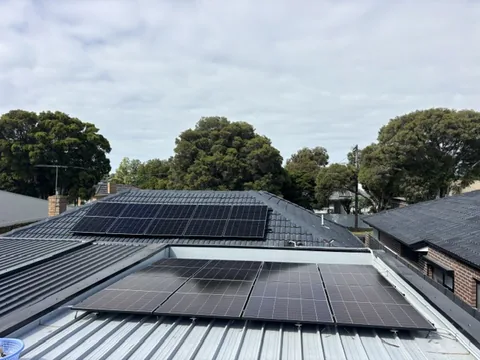
From one of our jobs
A finished array split across two roof faces
Photographed on site in Melbourne’s west. REC 37223.
What there is instead is a set of design constraints that come from how greenfield estates are laid out: low pitch roofs, orientation set by the street, narrow lots, and a local network where a lot of your neighbours already have solar feeding into it.
Low pitch Colorbond and what it means
Roofs here sit at a low 20 to 22 degrees on new trusses, mostly Colorbond with some lightweight tile. Sheet roofs are the easiest surface in the region to mount on: clamps rather than tile hooks on most profiles, no breakage allowance, and a faster day on site.
The low pitch costs a little winter output against a steeper roof and it also means panels self clean less readily, so on a dusty estate edge they benefit from an occasional rinse. Neither is a reason to add tilt frames on a suburban roof in an exposed corridor.
Clamps, not hooks
Klip-lok and similar profiles clamp to the sheet ribs, so most installs need no roof penetration at all.
No tile breakage
Sheet roofs avoid the spare tile allowance that older Geelong suburbs need, which shows up in the labour cost.
Rinse occasionally
Low pitch panels shed dust more slowly, and this corridor still has open paddock either side of it.
Orientation the street grid handed you
Estate homes are oriented to the road, not to the sun. Plenty of Armstrong Creek houses end up with their main planes facing east and west, and the temptation is to cram the array onto whatever short north section exists over a portico or a rear wing.
Usually the better answer is a split east and west array on the full planes. It gives clean rows, correct setbacks and a longer generating day, which suits a household that is out at 9am and back at 5pm far better than a narrow midday peak that gets exported for almost nothing.
Split beats cramming
Two full planes with proper setbacks outperform a squeezed layout on a short north section.
Match the household day
Morning and afternoon generation lines up with when people are actually home in a commuter estate.
Separate inputs
Each orientation gets its own string or MPPT input so the weaker side does not limit the stronger one.
Slab on ground and where cables can go
There is no subfloor here, so new circuits run through the roof space and drop down a wall cavity. On a new truss roof that is straightforward, but it limits where a run can come down, particularly on a two storey home with a rendered facade.
That decides inverter position more than aesthetics do. We find the compliant location with the required clearances, then plan the DC and AC routes around it, and we do that at survey rather than discovering the problem with panels already on the roof.
Roof space routing
New trusses give clear access above the ceiling, which keeps runs tidy and out of sight.
Drop points are limited
With no subfloor, the cable comes down a wall cavity, and not every wall offers a clean path to the board.
Two storey adds setup
Double storey estate homes need more edge protection and sometimes a platform, which is a real quote line.
900mm paths and neighbours close by
Greenfield lots of 350 to 550 square metres with a double garage to the boundary usually leave a 900mm path down one side. That carries the cable, the crew and the panels, and it means staging matters more than it does on an older wide block.
Proximity matters for the equipment too. Inverters make a small amount of noise and are best not mounted on a bedroom wall of the house next door. On lots this tight, that consideration comes before convenience when we choose the position.
Staging planned at survey
Where the panels are unloaded and lifted is worked out beforehand on a lot with one narrow access path.
Inverter noise and neighbours
Position is chosen with the adjoining bedroom wall in mind, not just the shortest cable run.
Fences and finishes
New rendered walls and colorbond fencing damage easily, so protection during the install is part of the job.
Powercor, export limits and price
Powercor is the distributor here and at our Altona workshop, so the pre-approval process is familiar. In a corridor where a large share of homes already export, limits are more common than in an older suburb, and that reflects committed network capacity rather than your equipment.
A quality 6.6kW system is $4,500 to $8,500 before incentives and roughly $3,000 to $6,000 after federal STCs worth $2,000 to $3,000, with up to $1,400 through Solar Homes for eligible households under the $150,000 combined income cap from 1 July 2026. Note that Solar Homes requires the property to meet its own eligibility rules, which we check before quoting on a new build.
Approval before energising
The application goes in before install day and the outcome, including any limit, is confirmed in writing.
Eligibility checked early
On very new homes we confirm rebate eligibility before quoting rather than assuming it applies.
Booked in blocks
Armstrong Creek is about 70km from Altona, so it is scheduled into a planned Geelong visit.
On the ground
Armstrong Creek estate notes
- Everything here was built to current wiring rules from about 2011 onward, so residual current protection and a modern board are already in place and the work is addition rather than remediation.
- Colorbond and lightweight tile on new trusses at a low 20 to 22 degrees in sound condition, which makes for fast clamp mounted installs with no tile breakage allowance.
- Slab on ground with no subfloor means circuits run through the roof space and drop down a wall cavity, which limits where the inverter can sensibly go.
- Lots of 350 to 550 square metres with double garages to the boundary leave a 900mm path on one side, so staging and equipment placement are planned before install day.
Licensed and accredited work by a local team. Read about Pivot Trade Services or see recent jobs across the western suburbs.
Answers
Armstrong Creek questions
A quick one, yes, but it rarely finds a problem. Armstrong Creek homes were built to current rules with residual current protection and a modern board. What we check is spare capacity, because solar plus a future battery and EV charger fill a board faster than most people expect on a new home.
Because estate homes are oriented to the street, not to the sun. The subdivision layout came first. It is common through this corridor, and the answer is usually a split east and west array on the full planes rather than squeezing panels onto a short north section over a portico or rear wing.
More likely than in an established suburb. Powercor sets limits from capacity already committed in the local network, and in a corridor where a high share of new homes already export, that capacity is under pressure. It is not about your system, and a limit matters little when the array is sized around daytime use.
Slightly, yes. Most sheet profiles clamp to the ribs rather than needing tile hooks, so there are no penetrations to seal on many roofs, no spare tile allowance and no breakage risk. The saving is in labour rather than equipment, and it is one of the few cost advantages of a new estate home.
Wherever there is compliant clearance and a sensible cable path, which on a 350 to 550 square metre lot is often one location rather than a choice. We also avoid mounting it on a wall directly opposite a neighbouring bedroom. That is decided at survey so the cable route can be planned around it.
Not quickly, and we say so before you book. We are in Altona, about 70km away, and Geelong work runs in scheduled blocks. Faults get triaged by phone and monitoring first, then a booked visit in the next planned run. If you need same day attendance, a local contractor is the right choice.
Other work we do in Armstrong Creek
- Electrician in Armstrong CreekNew homes built ready for the gear that goes in next
- Home battery in Armstrong CreekNew homes, narrow lots, easy electrics
- EV charger in Armstrong CreekHouses built ready for this, so the job is addition not repair
- Split system in Armstrong CreekNew houses, tight lots, and the neighbour on the other side
- Heat pump hot water in Armstrong CreekNew houses, narrow lots, and a rebate age test
Get a Armstrong Creek quote
Tell us the address and what you need. We quote Armstrong Creek 3217 and the surrounding western suburbs in writing, with no obligation.
- Free
- On-site quotes
- Fixed
- Written pricing
- 100%
- Workmanship guarantee
- 5.0★
- 69 Google reviews