
One of the easier suburbs to install in
Solar Panel Installation in Grovedale
Almost nothing in Grovedale predates 1965, which removes most of the complications that slow a job down in the older parts of Geelong. The wiring is PVC, the roofs are sound, the blocks are wide and the street grid throws up plenty of north facing planes.
- Grovedale 3216
- Powercor network
- REC 37223
The short answer
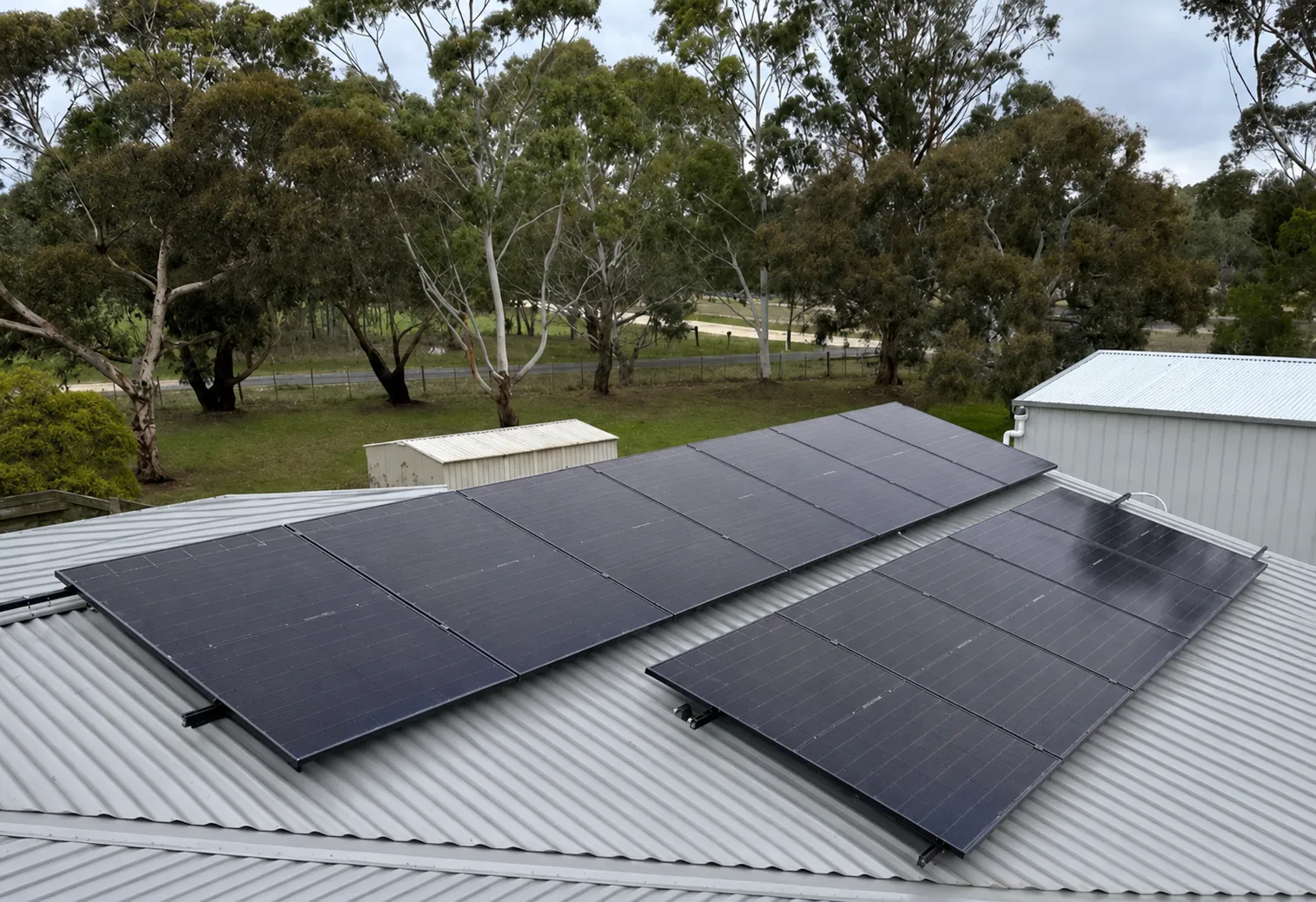
Grovedale 3216 is one of the simplest suburbs in Geelong to install solar in. The 1970s to 1990s brick veneer sits on 600 to 750 square metre blocks with a gate wide enough to run cable to the rear, and the concrete tile hips at around 22 degrees on a grid off the Surf Coast Highway give plenty of north facing plane. Wiring is PVC rather than rubber, so the usual constraint is spare ways at the switchboard, not the cable in the wall. Powercor approves the connection.
What is left is a capacity question rather than a safety one. A 1970s or 1980s board is usually serviceable and usually full, so the conversation here is about where a solar circuit goes and what else you might want to add to that board later.
Why the roofs work here
Concrete tile hips at around 22 degrees on the 1970s and 1980s stock, Colorbond on the newer estate pockets to the west and south. Both take a standard array without tilt frames, and single storey construction keeps access and setup costs down.
The grid layout off the Surf Coast Highway means a large share of homes have a genuine north facing plane rather than the east to west split you get on the long inner city allotments. That makes a full 6.6kW on one face the normal outcome rather than the lucky one.
Real north planes
The street grid orientation gives most homes a usable north face, so arrays rarely need splitting across three roofs.
Flush mounting suits 22 degrees
The pitch is close enough to optimum that tilt frames add wind load and cost for very little extra output.
Single storey access
Most homes here are single storey, which keeps setup, edge protection and labour lower than a two storey estate house.
Wide side access is worth real money
On the 1970s and 1980s streets a gate wide enough to take a trailer means the cable run from array to switchboard is short, external and tidy, and the crew can set up next to the house rather than staging everything through the front door.
It is worth knowing that before comparing quotes. The same 6.6kW system costs less to install here than on a boundary to boundary cottage in Geelong West, and if a quote for Grovedale is priced as though access is difficult, something is wrong with the quote.
Short external DC run
A clear side path means the cable route is direct rather than threaded through a ceiling space.
Setup next to the work
Room to stage panels and access the roof from the side is the difference between a one day and a longer job.
Tighter in the 1990s pockets
Blocks drop toward 450 to 550 square metres in the later streets, where access narrows and the run gets longer.
Spare ways, not rewiring
Because the stock is post 1965, wiring here is PVC rather than the rubber insulation found in the prewar suburbs. Rewiring is rarely the issue. The common upgrade is capacity, and the specific problem is a 1970s or 1980s board with no spare ways left.
That is what turns a straightforward solar install into a board job, and it is also why an EV charger quoted later so often comes back with an extra line on it. If storage or a charger is on the horizon, we lay the board out once with room for all of it.
Count the ways at survey
A full board is the single most common reason a simple Grovedale job grows, so we check it before quoting.
PVC, not rubber
Post 1965 wiring means remediation is uncommon here compared with the prewar suburbs closer to the city.
Plan for what comes next
Solar, battery and charger all want space on the board. Laying it out once is cheaper than reworking it twice.
Sizing when the roof is not the limit
When a roof easily takes 10kW, the temptation is to fill it. The maths says otherwise for most households. Victorian exports pay under 5 cents while peak imports run 30 to 45 cents, so panels only pay when something is running while they generate.
The honest answer for a lot of Grovedale families is 6.6kW plus load shifting, then reassess once an EV or a battery is actually in the driveway. If the house does have daytime occupancy or a pool pump, going larger genuinely stacks up, and we will say so.
Daytime load decides it
Occupancy, hot water timing and any pool or workshop load matter more than the square metres available.
Hot water first
Moving hot water into the middle of the day is the cheapest way to lift self consumption on an existing system.
Expandable design
Choosing an inverter with headroom means adding panels later does not mean replacing the inverter.
Powercor, rebates and how we get here
Powercor is the distributor in Grovedale and also at our Altona workshop, so the pre-approval paperwork is the process we run every week. Powercor sets any export limit based on committed capacity in your local network, and we confirm the outcome before the system is energised.
A quality 6.6kW system runs $4,500 to $8,500 before incentives and roughly $3,000 to $6,000 after federal STCs worth $2,000 to $3,000, with up to $1,400 more through Solar Homes for eligible households under the $150,000 combined income cap from 1 July 2026. Grovedale is about 70km from us, so it is booked into a planned Geelong block.
STCs already in the price
Certificates are assigned to the installer and deducted from the invoice, so there is nothing to claim later.
Solar Homes checked first
Eligibility is confirmed before quoting rather than assumed, because the income cap rules a lot of households out.
Week, not hour
Geelong work is scheduled in blocks from Altona. We give you a week, then confirm the day closer to the time.
On the ground
Grovedale site notes
- Almost nothing here predates 1965, so wiring is generally PVC rather than rubber and the common upgrade is capacity rather than replacement.
- 1970s and 80s boards frequently have no spare ways left, which is the usual reason a simple solar or EV charger job turns into board work.
- Blocks of 600 to 750 square metres on 16 to 20 metre frontages with a gate wide enough to run cable to the rear, tightening to 450 to 550 in the 1990s pockets.
- Concrete tile hips at around 22 degrees on the older stock and Colorbond on the newer estates, with the grid off the Surf Coast Highway yielding plenty of north facing planes.
Licensed and accredited work by a local team. Read about Pivot Trade Services or see recent jobs across the western suburbs.
Answers
Grovedale questions
Access and roof simplicity. A wide gate, a clear side path and a single storey tiled hip mean a short external cable run and straightforward setup. An inner Geelong cottage on both boundaries needs roof cavity routing and constrained access for the same kilowatts. The equipment is identical, the hours on site are not.
No, but it adds work. A 1970s or 1980s board with no spare ways cannot take a solar circuit without modification, and that is the most common extra cost in Grovedale. We check the board at survey and price it upfront. If a battery or charger is likely later, we lay the board out once for all of it.
Almost never. Grovedale housing is post 1965, so the wiring is PVC rather than the rubber insulation that causes trouble in the prewar suburbs. What we do check is mains size and spare capacity, because the houses were built for a smaller load than a modern kitchen, heat pump and charger add up to.
Only if something uses it during the day. Exports pay under 5 cents in Victoria now while peak imports cost 30 to 45 cents, so extra panels earn very little unless a pool pump, an EV or daytime occupancy soaks it up. For most Grovedale households 6.6kW plus load shifting is the better value decision.
Yes, mainly in access. The 1990s pockets run 450 to 550 square metres with tighter setbacks and often a garage to the boundary, so the cable route is longer and setup is more constrained. Roofs are frequently Colorbond rather than tile there, which installs faster and with no breakage allowance.
Grovedale is about 70km from our workshop, so it goes into a planned Geelong block rather than a same day booking. You get a nominated week, then a confirmed day, and a site visit before the quote is fixed. We do not offer emergency or after hours attendance at this distance.
Other work we do in Grovedale
- Electrician in GrovedaleModern enough wiring, boards that ran out of room
- Home battery in GrovedaleWide blocks, short runs, tight boards
- EV charger in GrovedaleEasy access, and a board that is probably full
- Split system in GrovedaleEasy blocks, modern wiring, and a board with no spare ways
- Heat pump hot water in GrovedaleWide gates, modern cable, and a board with no spare ways
Get a Grovedale quote
Tell us the address and what you need. We quote Grovedale 3216 and the surrounding western suburbs in writing, with no obligation.
- Free
- On-site quotes
- Fixed
- Written pricing
- 100%
- Workmanship guarantee
- 5.0★
- 69 Google reviews