
New houses, tight lots, and the neighbour on the other side
Split System Installation in Armstrong Creek
Armstrong Creek is the newest housing in the region, built from about 2011 onward on slab with no earlier residential stock behind it. Everything was constructed to current wiring rules, so the work here is almost always addition rather than remediation.
- Armstrong Creek 3217
- Powercor network
- REC 37223
The short answer
Armstrong Creek 3217 is entirely 2010s and 2020s estate housing on 350 to 550 square metre lots with double garages to the boundary, so the condenser usually has to sit in a side path of roughly 900mm. With houses that close together, noise at the neighbour boundary is the practical constraint on where it can go. Boards are modern and built to current rules. Homes under two years old do not qualify for the VEU discount. Powercor is the distributor.
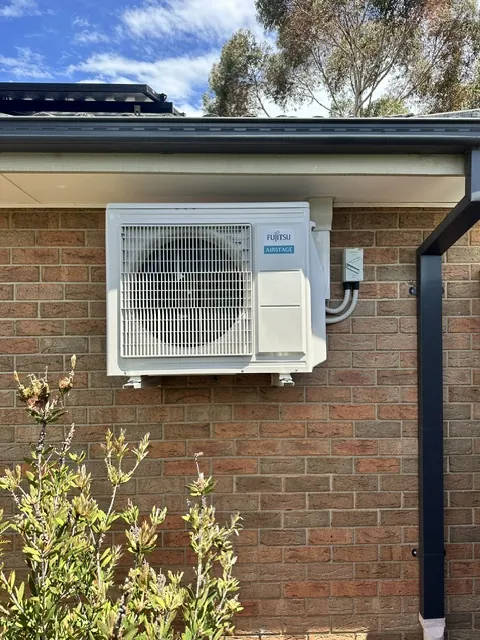
From one of our jobs
Outdoor units set on level mounts, clear of the fence line
Photographed on site in Melbourne’s west. REC 37223.
The limit is the lot, not the electrics. Greenfield frontages of 12.5 to 16 metres with a double garage to one boundary leave a single path of about 900mm, and that path sits between your wall and a neighbour wall about the same distance away.
The noise setback decides the position
On a lot this width, a condenser in the side path is a running compressor a couple of metres from a neighbour bedroom window. It is the single most common reason we move a proposed position, and it is far easier to solve before installation than after a complaint.
The practical rules are simple. Keep the unit away from bedroom windows on both sides, avoid boundary corners where two hard surfaces reflect sound back out, and mount it so no vibration is carried into the frame. Inverter condensers run around 50 to 60 decibels at a metre, which is fine at a distance and noticeable at two.
Map the neighbour
We look at what is on the other side of the fence before choosing a wall, not after.
Not in the corner
A condenser tucked into a boundary corner reflects its own noise rather than letting it disperse.
Isolate the mount
Rubber feet on a pad or isolators on a bracket keep structure borne noise out of both houses.
Slab on ground and where the pipework runs
There is no subfloor here, so new circuits and pipe routes go through the roof space and down inside a wall cavity. On a new truss roof that is straightforward work, but it does limit where a run can drop down, because a truss layout and a slab together leave fewer options than an older house on stumps.
We plan the route at the quote. A head on an internal wall may need a longer run and a condensate pump where gravity fall is not available, an indicative $250 to $500. Knowing that before the equipment is chosen is what keeps the price stable.
Roof space routes
New trusses give clean access, but the drop down a wall has to land where the cavity allows.
Condensate fall
Every head needs a drain with fall the whole way, or a pump where the route cannot deliver it.
Sealed penetrations
Wall penetrations get sealed and flashed properly, which matters on a lightweight modern facade.
Sizing a new estate home
Modern insulation genuinely reduces the heat load, so an Armstrong Creek bedroom often takes 2.5kW where a Corio bedroom the same size wants 3.5kW. The offsetting factor is glass. Estate homes have large window and sliding door areas, often single glazed, and tight setbacks mean neighbouring houses provide no shading.
Geelong is drier than Melbourne, sitting in the Otway rain shadow, and summer heat here comes with strong sun and little cloud. A west facing living area with a large slider is the room that decides the system, and it is regularly a size larger than the floor plan implies.
2.5kW
A standard estate bedroom with insulated cavity walls and a modern ceiling.
3.5kW
A bedroom with a large west facing window, or a room over a garage with no heated space beneath.
5.0 to 7.1kW
Open plan living, dining and kitchen, with the higher figure where a west facing slider is involved.
Single head or multi head on a greenfield lot
Where the side path holds one condenser and the rear yard is small, a multi head serving two to five heads keeps the outdoor footprint to one unit and one set of clearances. On these lot widths it is frequently the sensible answer.
Where the rear yard has room behind the garage, separate single head systems are worth the second outdoor unit. They run at their best efficiency in each room, and a fault takes out one room rather than every conditioned space in the house.
One unit, several heads
Multi head shares a compressor, so all heads run in the same mode and part load efficiency is lower.
Separate systems
Better efficiency per room and independent failure, where the block can take a second condenser.
Builder provisions
Some homes here were handed over with pipework roughed in. Worth checking before designing around it.
The two year rule, cost and scheduling
This matters more in Armstrong Creek than anywhere else in the region. Victorian Energy Upgrades requires the property to be at least two years old, so a house handed over last year does not qualify, no matter how efficient the equipment is. On older parts of the estate the discount applies, comes off the invoice directly, has no income test and carries a $200 including GST minimum contribution. The program changed on 30 September 2026.
Installed cost runs $2,500 to $7,500 depending on capacity and head count. Armstrong Creek is about 70km from our Altona workshop, so we book work here in planned blocks and give you a nominated week rather than an hour.
Check the handover date
The property age test is the first thing we confirm on a new estate home before mentioning a discount.
Builder warranty
On a recent handover, check whether penetrations affect any remaining builder or waterproofing warranty.
Licensing
ARC licensed refrigerant work, REC 37223 electrical, Certificate of Electrical Safety on completion.
On the ground
Armstrong Creek specifics
- Greenfield lots of 350 to 550 square metres with a double garage to the boundary usually leave one side path of about 900mm, and outdoor unit placement has to consider the neighbour noise setback before anything else.
- Everything was built to current wiring rules, so residual current protection and a modern board are already in place and the work is addition rather than remediation.
- Slab on ground with no subfloor means new circuits and pipe runs go through the roof space, which is easy on a new truss roof but limits where a run can drop down a wall.
- Houses handed over within the last two years do not meet the Victorian Energy Upgrades property age test, which catches a real number of homes in this estate.
Licensed and accredited work by a local team. Read about Pivot Trade Services or see recent jobs across the western suburbs.
Answers
Armstrong Creek questions
Close enough that placement is the main design decision on these lots. A condenser in a 900mm side path sits a couple of metres from a neighbour wall, so we keep it away from bedroom windows on both sides, out of reflecting boundary corners, and on isolating mounts. Getting that right first time avoids a conversation over the fence later.
No. Victorian Energy Upgrades requires the property to be at least two years old, and that catches a real number of homes in this estate. There is no income test and a $200 including GST minimum contribution once you do qualify. We check the handover date before putting any discount figure in a quote.
Usually smaller, then bigger again for the glass. Modern insulated cavity walls and ceilings genuinely cut the load, so an Armstrong Creek bedroom often takes 2.5kW where an older Corio bedroom wants 3.5kW. Large single glazed sliders facing west, with no shading from neighbours, is what pushes living areas back up.
Through the roof space and down inside a wall cavity, because there is no subfloor. New trusses make the roof part easy. The constraint is where the run can drop, since the truss layout and the wall framing decide that. We map the route at the quote so the head position is not a surprise on the day.
Sometimes, and it is worth checking rather than assuming. We look at the pipe size, the condition of the caps, whether it was pressure tested and where it terminates at both ends. If it suits the equipment being installed, it saves real money. If it does not, using it anyway causes problems we would have to come back for.
No. Armstrong Creek is about 70km from our Altona workshop and we book Geelong work in planned blocks, so you get a nominated week and a confirmed day closer to the time. If you need attendance within hours during a heatwave, a Geelong based contractor is the right call and we will say so.
Other work we do in Armstrong Creek
- Electrician in Armstrong CreekNew homes built ready for the gear that goes in next
- Solar installation in Armstrong CreekNew roofs, narrow lots, orientation you did not choose
- Home battery in Armstrong CreekNew homes, narrow lots, easy electrics
- EV charger in Armstrong CreekHouses built ready for this, so the job is addition not repair
- Heat pump hot water in Armstrong CreekNew houses, narrow lots, and a rebate age test
Get a Armstrong Creek quote
Tell us the address and what you need. We quote Armstrong Creek 3217 and the surrounding western suburbs in writing, with no obligation.
- Free
- On-site quotes
- Fixed
- Written pricing
- 100%
- Workmanship guarantee
- 5.0★
- 69 Google reviews