
Wide blocks, short runs, tight boards
Home Battery Installation in Grovedale
Grovedale is 1970s to 1990s brick veneer built as Belmont spread south, with 2000s estate housing on the western and southern edges. For a battery that is close to ideal. The blocks are wide, the wiring is modern enough to build on, and the roofs face the right way often enough to produce a real surplus.
- Grovedale 3216
- Powercor network
- REC 37223
The short answer
Home battery installation in Grovedale 3216 is one of the more straightforward jobs in the region. Blocks of 600 to 750 square metres on 16 to 20 metre frontages usually have a gate wide enough to run cable to the rear, which keeps the run short and the price honest. Almost nothing here predates 1965, so wiring is PVC rather than rubber. Grovedale is a Powercor address, and the usual constraint is spare ways at a 1970s or 80s board rather than the cable in the wall.
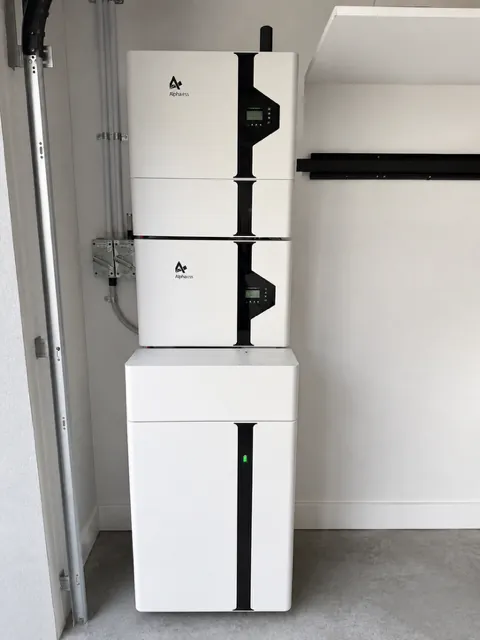
From one of our jobs
Battery and inverter stacked inside the garage
Photographed on site in Melbourne’s west. REC 37223.
The one thing that trips these jobs up is the board. A 1970s or 80s switchboard frequently has no spare ways left, which is the usual reason a simple battery install turns into a board job. It is worth knowing that before comparing quotes, because not every quote will have looked.
Why access makes this suburb cheaper to work in
On the 1970s and 80s streets, blocks run 600 to 750 square metres on 16 to 20 metre frontages and most have a gate wide enough to get equipment and cable to the rear. That single fact makes cable runs cheaper here than in the inner suburbs, and cable is a real line on a battery quote rather than a rounding error.
The 1990s pockets tighten toward 450 to 550 square metres and the access narrows with them, so it is not uniform across the suburb. But compared with a Geelong West cottage on both boundaries, almost anything in Grovedale is a straightforward run from the switchboard to a garage wall.
Wide gates, short runs
Access to the rear on the older blocks keeps conduit and labour down, which shows up directly in the price.
The 1990s pockets are tighter
Lots of 450 to 550 square metres in the newer streets narrow the access, so it is checked by address.
Compare like with like
A cheaper Grovedale quote often reflects easier access rather than cheaper equipment. Ask which.
Spare ways are the real constraint
1970s and 80s boards frequently have no spare ways left, and that is the usual reason a straightforward job here turns into a board job. A battery installation adds circuits and normally a backup sub-board, and both need somewhere to land.
It is a smaller problem than in Corio or Belmont, because the wiring itself is generally PVC rather than rubber and the protection is usually breakers rather than ceramic fuses. Often the answer is a sub-board or a board extension rather than a full replacement. Where a full upgrade is needed it runs $800 to $3,500 or more.
Count the ways before quoting
Photographing the board with the cover off answers most of this question before anyone drives down.
Extension beats replacement
Where the existing board is sound, adding capacity is often cheaper than replacing the whole thing.
Capacity, not remediation
Post-1965 wiring means the usual Grovedale upgrade is about room to add circuits, not fixing what is there.
Sizing against a full daily cycle
The grid layout off the Surf Coast Highway yields plenty of north-facing planes, and concrete tile hips at around 22 degrees on the older stock suit an array well. That means the daily surplus is genuinely there, which is the single best predictor that a battery will pay.
Sizing still comes from evening consumption between roughly 5pm and midnight. For most Grovedale households that lands at 10kWh to 13kWh usable. Above 14kWh the federal support tapers, so the marginal cost of extra capacity climbs and it has to justify itself purely on how often you actually cycle it.
North planes are common
The street grid off the highway gives a good share of north-facing roof, which is why arrays here perform.
Cycle depth drives return
A battery that fills and empties daily repays roughly twice as fast as one that half fills.
The 14kWh taper
Federal support reduces above 14kWh usable, which is a natural stopping point for most households here.
Cost, the federal discount and payback
A 10kWh battery is $8,000 to $12,000 installed before rebates and $5,500 to $9,500 after the federal Cheaper Home Batteries discount. That discount is roughly 30 percent, about $250 per usable kilowatt hour from 1 May 2026, taken off your installed price by the accredited installer rather than claimed by you afterwards.
Payback typically runs 7 to 10 years against a real world life of 12 to 15 years. Grovedale sits at the better end of that range because the array fills the battery and the access keeps the install cost down. The battery must be capable of joining a virtual power plant to qualify for the discount, although whether you enrol is a separate decision.
Net price, not headline
Some suppliers advertise before the discount and some after. Compare the amount actually payable.
Usable kilowatt hours
The discount and your savings both run off usable capacity, which is lower than the advertised size.
Rate steps down yearly
Support per kilowatt hour reduces annually, which is a genuine timing input rather than a sales line.
Backup circuits and the Powercor application
A grid-connected battery shuts down in a blackout unless it is specified for backup. That means backup-capable equipment, a gateway and a sub-board carrying nominated circuits. In Grovedale the sensible list is the fridge, some lights, the internet and a few power points, and on a family home the study or home office outlets are worth naming specifically.
Grovedale is Powercor. A battery inverter is a grid-connected inverter under AS/NZS 4777.2, so it needs its own application even where your solar was approved years ago. Powercor covers our own area in the western suburbs of Melbourne too, so it is the same lodgement we make weekly. We are about 70km away, so work here is booked into scheduled blocks.
Name the circuits
Backup is wired at install time from a list you nominate, so it is worth thinking about before the day.
Same application either side
Powercor runs the network here and in our own area, so nothing about the pre-approval path is unfamiliar.
Week, not hour
At 70km from Altona we schedule Grovedale work in blocks and tell you the week honestly.
On the ground
Grovedale battery notes
- Blocks of 600 to 750 square metres on the 1970s and 80s streets usually have a gate wide enough to run cable to the rear, which makes installs here cheaper than in the inner suburbs.
- Almost nothing predates 1965, so wiring is generally PVC rather than rubber and the common upgrade is capacity rather than replacement.
- 1970s and 80s boards frequently have no spare ways left, which is the usual reason a simple battery job turns into a board job.
- The street grid off the Surf Coast Highway gives plenty of north-facing planes, so the daily surplus needed to fill a battery is genuinely there.
Licensed and accredited work by a local team. Read about Pivot Trade Services or see recent jobs across the western suburbs.
Answers
Grovedale questions
Access, mostly. Grovedale blocks are 600 to 750 square metres with a gate wide enough to reach the rear, so the cable run from switchboard to garage is short and simple. A Geelong West cottage built to both boundaries needs a route through the roof space or around the front. Same equipment, genuinely different labour.
Possibly, once capacity is added. Boards of that era in Grovedale frequently have no spare ways left, and a battery adds circuits plus normally a backup sub-board. The wiring itself is usually PVC and the protection breakers, so a sub-board or an extension often solves it. A full upgrade runs $800 to $3,500 or more.
Usually yes, which is the main reason storage works in this suburb. The grid layout off the Surf Coast Highway gives plenty of north-facing planes and the tile hips sit at around 22 degrees, so arrays here produce a genuine midday surplus. A battery that fills and empties daily repays roughly twice as fast as one that does not.
For most Grovedale households, 10kWh to 13kWh usable. The number comes from what you consume between roughly 5pm and midnight, which twelve months of interval data from your retailer will tell you precisely. Above 14kWh the federal support tapers, so extra capacity costs proportionally more and has to earn its place on cycling alone.
Yes. A battery inverter is a grid-connected inverter under AS/NZS 4777.2, so it changes the inverter capacity at your connection point and gets assessed afresh. Powercor covers the whole Geelong region, and we submit the application before booking the installation rather than after the equipment arrives.
The same way we handle installs, by scheduling them into a Geelong block. We are about 70km away, so we will give you a week rather than an hour. A battery is planned equipment with a 100% workmanship guarantee on top of the manufacturer warranty, and nothing about it needs same-day attendance.
Other work we do in Grovedale
- Electrician in GrovedaleModern enough wiring, boards that ran out of room
- Solar installation in GrovedaleOne of the easier suburbs to install in
- EV charger in GrovedaleEasy access, and a board that is probably full
- Split system in GrovedaleEasy blocks, modern wiring, and a board with no spare ways
- Heat pump hot water in GrovedaleWide gates, modern cable, and a board with no spare ways
Get a Grovedale quote
Tell us the address and what you need. We quote Grovedale 3216 and the surrounding western suburbs in writing, with no obligation.
- Free
- On-site quotes
- Fixed
- Written pricing
- 100%
- Workmanship guarantee
- 5.0★
- 69 Google reviews