
Scheduled work in the city, booked in blocks
Home Battery Installation in Central Geelong
Central Geelong is a commercial core with people living in it. Above-shop dwellings, converted warehouses, apartments on the waterfront and a thin band of older houses behind Moorabool Street. That mix is why a battery quote here starts with a question the suburbs never ask: where can eighty kilograms of equipment legally and sensibly be fixed.
- Geelong 3220
- Powercor network
- REC 37223
The short answer
Home battery installation in central Geelong 3220 is decided by where the unit can physically go. City allotments are built hard to the street and both side boundaries, so there is no side access and cable runs go up an internal riser or in from a rear laneway. Geelong is a Powercor address, so the battery inverter needs a Powercor application. Three phase supply is common in this mixed use core, and waterfront buildings on Corio Bay carry real salt exposure that rules out an exposed external wall.
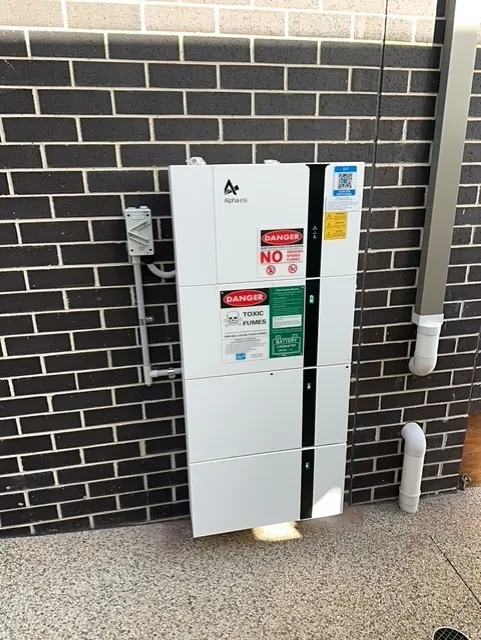
From one of our jobs
Battery and inverter mounted with full isolation labelling
Photographed on site in Melbourne’s west. REC 37223.
We are based in Altona and drive about 60km to get here, so city work is booked in blocks rather than attended on demand. That suits a battery well. Storage is planned work with a Powercor application in front of it, and there is nothing about it that benefits from being rushed.
Finding a compliant position with no side access
City allotments are built to the street and to both side boundaries. There is no side passage to run a cable down and often no garage to mount a battery in. That removes most of the positions a battery installer would use in Grovedale or Corio without thinking about it.
What works instead is a rear store, a laneway-facing wall under cover, a basement car space where one exists, or a floor-standing unit rather than a wall-mounted one. Wall structure matters too, because a 19th century single-brick wall was not built to carry a modern battery pack. We look at the building before we quote the equipment.
Rear laneway first
Where a rear laneway exists it is usually the shortest cable route and the easiest position to service later.
Floor-standing beats wall-mounted
On single-brick and bluestone walls a floor-mounted unit avoids hanging serious weight on masonry that was never designed for it.
Fire separation rules out most walls
Separation from habitable rooms and exit paths excludes a lot of positions in a building with no spare footprint.
Salt off Corio Bay and enclosure choice
Buildings along the waterfront carry genuine marine salt exposure, and a battery is the worst possible thing to put in it. Batteries need ventilation to stay inside their temperature range, and that same airflow carries salt-laden air to the electronics inside the enclosure.
So on any address close to the bay we look for an indoor or fully sheltered position first. Where an outdoor location is unavoidable, the enclosure rating, the weather protection over it and the fixings all have to reflect direct exposure, not a general-purpose specification.
Ventilation is the vulnerability
The vents that manage battery temperature are the path salt takes inside. Shelter solves the problem better than any coating.
Sheltered beats convenient
A slightly longer cable run to a protected position is cheaper than replacing an enclosure in year six.
Match the isolators
Isolators, conduit and fixings around the battery need the same coastal specification the enclosure does.
What it costs and what the federal discount covers
A 10kWh battery is $8,000 to $12,000 installed before rebates and $5,500 to $9,500 after the federal Cheaper Home Batteries program, which has run since July 2025. The discount is roughly 30 percent, calculated at about $250 per usable kilowatt hour from 1 May 2026, so about $2,500 on a 10kWh system, and it tapers above 14kWh.
It is applied by the accredited installer as a line off your installed price, so there is nothing to claim afterwards. The battery has to be capable of joining a virtual power plant to qualify, though you are not obliged to enrol in one. The rate steps down annually, which is a real timing consideration rather than a sales tactic.
Compare the net figure
Some suppliers advertise before the discount and some after. Compare the amount payable, not the headline.
Usable, not nameplate
Both the discount and your evening savings run off usable kWh, which is always lower than the advertised size.
VPP capable, not VPP enrolled
The battery must be able to join a virtual power plant. Whether you enrol is a separate decision made later.
Backup circuits, Powercor and how we schedule city work
A standard grid-connected battery shuts down in a blackout for line worker safety. Keeping power on needs a backup-capable battery, a gateway and a sub-board carrying nominated circuits. In an apartment or an above-shop dwelling that list is usually short and specific, because the loads worth backing up are the fridge, the internet and a home office rather than a whole house.
Geelong is Powercor, the same distributor we lodge with every week in the western suburbs of Melbourne, so the battery inverter application is a process we already run rather than one we are learning. We are 60km away, we book city jobs in blocks, and we will tell you the week rather than pretending to give you the hour.
Nominate circuits at design
Backup is wired at install time. It is not a setting that can be enabled later from an app.
Lodged before install day
The Powercor application goes in before we book the installation, not after the equipment is on the wall.
A week, not an hour
We travel 60km to get here, so city work is scheduled honestly in blocks rather than sold as same-day attendance.
On the ground
Central Geelong battery notes
- City lots are built to both boundaries with no side access, so a battery position is usually a rear store, a laneway wall or a basement car space rather than a garage.
- Three phase supply is common in the mixed use core, which allows a higher output hybrid inverter and a backup board that carries more than the bare essentials.
- Shared tenancy metering means the battery has to be confirmed behind the correct meter before design, particularly in above-shop dwellings.
- Waterfront buildings on Corio Bay have real marine salt exposure, which makes a ventilated outdoor enclosure a poor choice on an exposed elevation.
Licensed and accredited work by a local team. Read about Pivot Trade Services or see recent jobs across the western suburbs.
Answers
Geelong questions
Sometimes, but it is decided by the building rather than the product. You need a position with the required clearances, separation from habitable rooms and exit paths, and owners corporation consent for anything fixed to a common wall. A basement car space is often the workable answer. We look at it in person before quoting, because two apartments in the same block can differ.
Not usually, but it changes the route and the price. City allotments are built to both boundaries, so the cable run goes up an internal riser or in from a rear laneway instead of down a side path. That is longer and slower than a suburban run. It is a real line on the quote rather than a rounding error.
The one serving the dwelling, and it has to be confirmed before anything is designed. Mixed use buildings in the city core often have metering shared or arranged across tenancies, and a battery wired behind the wrong meter charges and discharges against the wrong account. We trace it at the switchboard first.
Yes, in two ways. A three phase hybrid inverter delivers higher output, so a backup sub-board can carry more circuits than a single phase system manages. And a three phase connection usually leaves headroom for a battery and an EV charger without a supply upgrade. Three phase is more common in central Geelong than in most residential suburbs.
Yes. A battery inverter is a grid-connected inverter under AS/NZS 4777.2, so it changes the inverter capacity at your connection point and needs a fresh application even where solar was approved years ago. Powercor covers the whole Geelong region, so the same network assessment applies from Lara down to Torquay.
We are in Altona, about 60km away, so we book Geelong work in scheduled blocks rather than attending the same day. For a battery that is no disadvantage. The Powercor application has to be lodged and approved before energising anyway, so the job is planned work with a date, and we will tell you the week.
Other work we do in Geelong
- Electrician in GeelongScheduled city work, booked in blocks from our Altona workshop
- Solar installation in GeelongCity roofs, rooftop plant and the building next door
- EV charger in GeelongWhere the car park is usually not attached to the switchboard
- Split system in GeelongApartments, laneways and nowhere obvious for the outdoor unit
- Heat pump hot water in GeelongScheduled work in the city, 60km from our Altona workshop
Get a Geelong quote
Tell us the address and what you need. We quote Geelong 3220 and the surrounding western suburbs in writing, with no obligation.
- Free
- On-site quotes
- Fixed
- Written pricing
- 100%
- Workmanship guarantee
- 5.0★
- 69 Google reviews