
Heritage overlay first, capacity second
Split System Installation in Newtown, Geelong
Newtown work is period work. Victorian, Edwardian and interwar Californian bungalows built between the 1850s and the 1940s, much of it inside heritage overlay precincts, on allotments of 600 to 900 square metres with one narrow side driveway.
- Newtown 3220
- Powercor network
- REC 37223
The short answer
Newtown 3220 is largely heritage overlay territory, covering the Newtown Hill, Newtown West, Newtown Chilwell and Clarkes Hill precincts, so a condenser or an indoor head visible from the street can need a planning permit before anything is installed. Victorian and Edwardian ceilings of three metres or more raise room volume well above what the floor plan suggests, which usually means 7.1kW where a modern room takes 5.0kW. Powercor is the distributor here.
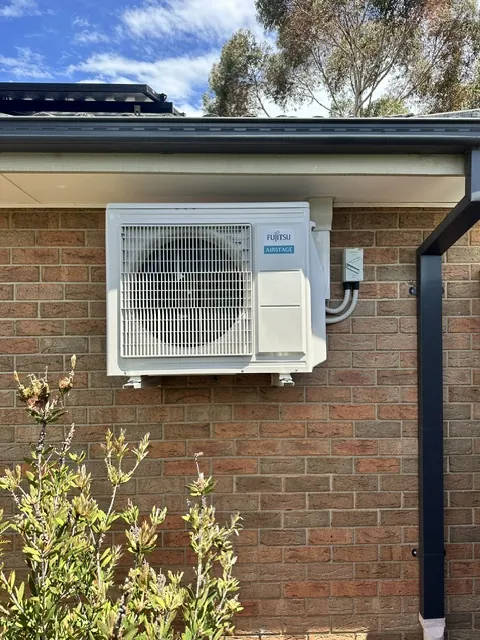
From one of our jobs
Outdoor units set on level mounts, clear of the fence line
Photographed on site in Melbourne’s west. REC 37223.
Two things follow. Whether equipment can be seen from the street is a planning question rather than a taste question, and the rooms hold far more air than their dimensions imply. Both get settled at the quote, because finding out on installation day is the expensive version.
What the overlay actually controls
Newtown Hill, Newtown West, Newtown Chilwell and Clarkes Hill are heritage overlay precincts, which means a planning permit is needed to alter a building exterior. Clarkes Hill alone covers 68 dwellings of which 54 are heritage significant, so this is not a technicality that gets waved through.
In practice the overlay is a siting problem, not a barrier. A condenser in a rear yard, on a side return behind the front building line or on a later addition is not the sort of change the controls exist to stop. A unit on a street facing wall of a Pakington Street end terrace is exactly that.
Behind the building line
Rear yards, side returns and later additions are the positions that keep a job simple.
Indoor heads count too
A head visible through a street facing window is rarely an issue, but a penetration through a street elevation can be.
Ask before you order
Where the only workable position is street facing, check with the City of Greater Geelong first. We supply the technical detail.
Ceiling height is the sizing factor
A 4 by 5 metre bedroom with a 2.4 metre ceiling holds 48 cubic metres of air. The same room under a 3.3 metre Newtown ceiling holds 66 cubic metres, and the system has to condition all of it. Warm air also stratifies above head height in a tall room, so the thermostat can be satisfied while the floor is still cold.
That is why we size on volume, glazing and orientation rather than floor area. A front lounge with a decorative ceiling, a bay window and an open flue regularly lands at 7.1kW where the same footprint in a Waurn Ponds estate house takes 5.0kW.
Measure the height
Three metre and 3.6 metre ceilings are normal in Newtown period homes and they change the calculation substantially.
Head position
Mounted higher on a tall wall and angled down, so conditioned air reaches the occupied zone rather than the cornice.
Seal the flue
An unused open fireplace is a direct path out for conditioned air. Sealing it is cheap and it changes how the room performs.
The narrow side driveway
Most Newtown blocks have a side driveway, which is more than the inner cottages get, but the gap between wall and boundary is tight. A condenser needs clearance in front of the discharge face and room to service it, and a unit squeezed against a paling fence recirculates its own hot air in February.
Where the driveway is too narrow, the rear yard is usually the answer, with the longer pipe run priced rather than absorbed. Additional pipe beyond the standard allowance is an indicative $80 to $130 per metre, which is worth knowing before comparing two quotes.
Clearance to the fence
Airflow off the discharge face matters more than the footprint. A boxed in unit runs hot and fails early.
Rear yard runs
Longer pipe costs an indicative $80 to $130 per metre and reduces delivered capacity, so it belongs in the design.
Slate roof access
Slate and heritage tile roofs limit roof space routes, which pushes pipework to external chases on many of these houses.
Old wiring, old boards and the dedicated circuit
Pre-1940s housing at this scale usually means rubber or cotton braided wiring somewhere in the roof space, and a board never designed for the load a modern kitchen puts on it. A split needs its own circuit and isolator, and that circuit has to land somewhere safe.
We test the board and the main earth as part of the assessment. Where an upgrade is required it appears as a separate line at $800 to $3,500 or more rather than being absorbed, so you can see what is heating and what is the house being brought up to standard.
Board first
Residual current protection and a tested main earth before any new circuit is added to a period installation.
Then the circuit
One dedicated circuit and isolator per head, indicatively $350 to $800 depending on the run.
Roof space care
Old rubber insulation crumbles when disturbed. We route around it rather than through it.
Gas replacement, cost and how we schedule
Many Newtown homes still run ducted gas or a wall furnace. Reverse cycle heats a room for roughly 28 to 36 cents an hour against 50 to 72 cents for ducted gas, worth about $200 to $450 a year. Victorian Energy Upgrades discounts apply straight to the invoice, no income test, property at least two years old, $200 including GST minimum contribution, and the program changed on 30 September 2026.
Newtown is about 65km from our Altona workshop and is not on the water, so standard condensers are appropriate here. We book Geelong work in planned blocks and give you a week rather than an hour, which is the honest version of a 65km drive.
Installed cost
$2,500 to $7,500 depending on capacity and head count, with more for long runs and difficult penetrations.
Core drilling
Solid masonry and rendered heritage walls take longer than brick veneer, an indicative $100 to $250 more per penetration.
Licensing
ARC licensed refrigerant work, REC 37223 electrical work, Certificate of Electrical Safety issued on completion.
On the ground
Newtown specifics
- Four heritage overlay precincts cover much of the suburb. Clarkes Hill alone is 68 dwellings with 54 heritage significant, so a street visible condenser is a planning question before it is an installation question.
- Ceilings of three metres and more are normal in the Victorian and Edwardian stock, which lifts room volume well above what the floor plan implies and pushes capacities up a size.
- The single narrow side driveway on a 600 to 900 square metre allotment usually gives access, but the gap to the boundary rarely leaves proper clearance for a condenser to breathe.
- Slate and heritage tile roofs restrict roof space routes, so pipework more often runs in an external chase here than through the ceiling.
Licensed and accredited work by a local team. Read about Pivot Trade Services or see recent jobs across the western suburbs.
Answers
Newtown questions
Very rarely. The overlay is concerned with what can be seen from the street and with original fabric, so a condenser in the rear yard, on a side return behind the building line or on a later addition is usually fine. If the only position is street facing, check with the City of Greater Geelong first.
Substantially. A room with a 3.3 metre ceiling holds nearly forty percent more air than the same footprint at 2.4 metres, and every cubic metre has to be conditioned. Warm air stratifies above head height as well, so head position and fan settings matter more here. We size Newtown rooms on volume, not floor area.
Sometimes, but often not. Slate and heritage tile roofs frequently have no safe access, and the structure over a Victorian home rarely offers the clear runs a duct network needs. Where the subfloor is generous an underfloor system is occasionally possible. In most of these houses, splits are the realistic answer.
Sometimes, but the clearance in front of the discharge face is what matters, not whether the unit fits. A condenser boxed in against a paling fence recirculates its own hot air and fails early. Where the driveway is too tight we site the unit in the rear yard and price the longer run properly.
Often, in this housing. Pre-1940s homes usually have rubber or cotton braided wiring in the roof space and a board with no spare ways left. Each head needs a dedicated circuit and isolator, so we test the board and main earth first and quote any upgrade separately at $800 to $3,500 or more.
No, and it is a genuine cost difference. Newtown is inland, so standard condenser coils and mounting hardware are appropriate here. The corrosion protected coils and stainless brackets we specify in Torquay and Ocean Grove are for open Bass Strait salt, and paying for them in a Newtown back yard buys nothing.
Other work we do in Newtown
- Electrician in NewtownOverlay precincts, and what they decide before anything is mounted
- Solar installation in NewtownThe overlay decides where the panels go
- Home battery in NewtownHeritage overlay first, equipment second
- EV charger in NewtownA heritage precinct decides where the unit can go
- Heat pump hot water in NewtownA heritage precinct decides where the unit sits
Get a Newtown quote
Tell us the address and what you need. We quote Newtown 3220 and the surrounding western suburbs in writing, with no obligation.
- Free
- On-site quotes
- Fixed
- Written pricing
- 100%
- Workmanship guarantee
- 5.0★
- 69 Google reviews