
A heritage precinct decides where the unit sits
Heat Pump Hot Water Systems in Newtown, Geelong
Newtown is Victorian, Edwardian and interwar housing built between the 1850s and the 1940s, and a large share of it sits inside a heritage overlay precinct. The Clarkes Hill precinct alone covers 68 dwellings of which 54 are heritage significant. On a hot water changeover that is not a technicality, because the outdoor unit is bulkier than the gas box it replaces and it has to sit somewhere.
- Newtown 3220
- Powercor network
- REC 37223
The short answer
Heat pump hot water in Newtown 3220 costs $3,000 to $4,500 supplied and installed before incentives, plus $800 to $3,500 where a pre-1940s switchboard has to be replaced first. Newtown Hill, Newtown West, Newtown Chilwell and Clarkes Hill are heritage overlay precincts, so a unit visible from the street is an external alteration that can need a planning permit. Powercor is the distributor. Blocks run 600 to 900 square metres with one narrow side driveway.
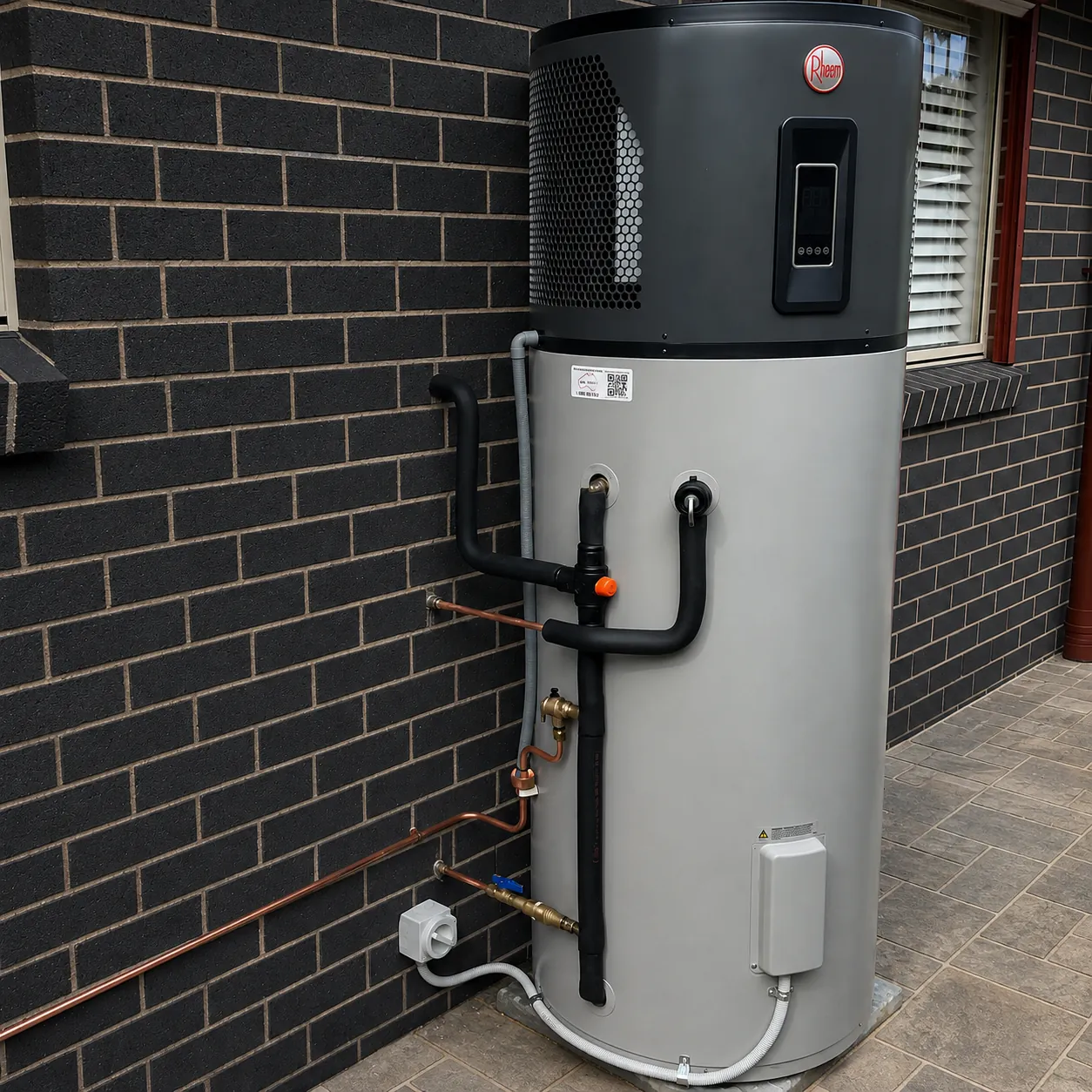
From one of our jobs
New electric heat pump replacing an old, expensive gas hot water unit
Photographed on site in Melbourne’s west. REC 37223.
The second Newtown factor is what is behind the meter box door. Pre-1940s stock at this scale often still has rubber or cotton-braided wiring in the roof space and a board that predates residual current protection. A heat pump needs its own dedicated circuit and isolator, and that board cannot provide one.
The heritage overlay and a unit visible from the street
A heritage overlay requires a planning permit to alter the exterior of a building. A heat pump outdoor unit bolted to a front or side wall in clear view from the footpath, with pipework and conduit running to it, is an exterior alteration in exactly the way a wall-mounted air conditioner or a solar array on a street-facing plane is. On the wide Newtown frontages where the old gas unit sat on the front side wall, that is the position people ask for first.
The workaround is the same one we use for panels here. Put the unit on a side or rear elevation that is not visible from the street, run the pipe and cable inside the wall cavity or the roof space rather than across the facade, and the overlay stops being the deciding factor. Where that genuinely cannot be done we say so at the assessment rather than at the installation.
Rear elevation first
A position out of view from the street avoids the permit question entirely and is usually better for noise as well.
Pipework is the giveaway
It is rarely the unit alone that offends a heritage assessment. It is the lagged pipe and surface conduit crossing a street-facing wall.
Flagged before quoting
If the only workable position needs a planning permit we tell you at the site visit, not after the old tank is on the truck.
Narrow side driveways and a bulkier appliance
The classic Newtown arrangement is a generous 600 to 900 square metre allotment with a single narrow driveway squeezed between the house wall and the boundary. There is side access, which puts Newtown well ahead of the inner cottage suburbs, but the gap is tight and a heat pump is physically larger than the gas unit or the slim electric tank it replaces.
Two things follow. The unit needs clearance on the intake and discharge faces, not just enough room to fit between the wall and the fence, and there has to be room to get the old tank out and the new one in past a parked car. We measure the pinch point rather than assuming the driveway width holds the whole way down.
Measure the pinch point
Driveways here narrow at the meter box or a chimney breast. The tightest point decides the route, not the width at the gate.
Clearance both faces
Air in one side, colder air out the other. A unit wedged against a paling fence recirculates its own discharge and loses efficiency daily.
Getting the old one out
A full storage tank is heavy and awkward. On a narrow drive the removal route is part of the quote, not an afterthought.
What is behind a pre-1940s Newtown board
Plenty of Newtown houses have been renovated properly and have a modern board with spare ways, in which case the hot water circuit is straightforward. Plenty of others have a beautifully restored front room and an original board behind the meter box door. A heat pump cannot be added to a board with no residual current protection and no spare capacity.
Board replacement runs $800 to $3,500 depending on whether the meter panel and consumer mains also need attention. We quote it as its own line so you can see which part of the invoice is the hot water system and which part is thirty years of deferred electrical work catching up. Rubber and cotton-braided wiring in the roof space is a separate conversation again, and worth having while someone is already up there.
Dedicated circuit and isolator
Non negotiable on a heat pump. It is the reason an old board turns a simple changeover into a two part job.
Board replacement $800 to $3,500
Driven by the meter panel and the consumer mains rather than by the hot water system itself.
Rubber wiring in the roof
Common in unrenovated pre-1940s stock here. We report what we find rather than quietly working around it.
What the changeover actually costs in Newtown
The appliance side is the same everywhere: $3,000 to $4,500 supplied and installed before incentives. Solar Homes contributes up to $1,000, or up to $1,400 for a locally made product, with a combined household income cap of $150,000 from 1 July 2026. Victorian Energy Upgrades applies a discount straight to the invoice, no income test, on properties at least two years old with a $200 including GST minimum contribution. Federal STCs are worth roughly $300 to $600. Most households end up paying from a few hundred dollars up to about $1,500.
The Newtown variable is everything around the appliance. A house with a modern board and a rear position lands at the bottom of that range. A house with an original board, a heritage-sensitive position and pipework that has to be run internally lands well above it. We price the two separately so the comparison against another quote is honest. VEU changed on 30 September 2026, so the discount is confirmed in writing on the day.
Appliance versus infrastructure
Two lines on the quote. One is the hot water system, one is the board and the making good the house needs anyway.
Heritage sensitive making good
Internal cable and pipe routes cost more labour than a surface run. That is the price of not putting conduit across a heritage facade.
Confirmed at quote
VEU changed on 30 September 2026, so we date the discount rather than repeating last season figure.
Running it on the roof you are allowed to use
Newtown roofs are hipped and gabled slate, terracotta and corrugated steel at 20 to 35 degrees, and the Newtown Hill guidelines specify that pitch range and discourage zincalume. Where panels have gone on, they are usually on the rear and side planes rather than the street-facing ones, so arrays here are often smaller than the roof area suggests.
A modest array still pairs well with a heat pump, because hot water is a small and completely shiftable load. Setting the heating cycle for the early afternoon uses generation that would otherwise export for a few cents, and it runs the compressor in the warmest air of the day. Geelong nights run a little cooler and drier than Melbourne, which makes the midday window worth more here than the old overnight controlled load habit.
Small arrays still work
Even 3 to 5kW on rear planes will typically carry an afternoon heating cycle for a normal household.
Timer set at commissioning
We set the window to match the generation you actually have and show you how to change it, rather than leaving factory defaults.
Cooler dry nights
Overnight heating in Geelong air costs more than it does in the afternoon. The timer is free and it is the biggest single running cost lever.
On the ground
Newtown specifics
- Newtown Hill, Newtown West, Newtown Chilwell and Clarkes Hill are heritage overlay precincts, and an outdoor unit visible from the street is an external alteration that can require a planning permit
- The Clarkes Hill precinct alone covers 68 dwellings of which 54 are heritage significant, so on those streets the overlay decides the position before anything technical does
- Blocks of 600 to 900 square metres with a single narrow side driveway are the norm, and a heat pump is bulkier than the gas unit it replaces
- Pre-1940s stock frequently has rubber or cotton-braided wiring in the roof space and a board with no residual current protection, which has to be sorted before a dedicated hot water circuit exists
Licensed and accredited work by a local team. Read about Pivot Trade Services or see recent jobs across the western suburbs.
Answers
Newtown questions
No, it constrains where it goes. A planning permit is required to alter a building exterior in the Newtown overlay precincts, and an outdoor unit with lagged pipe and conduit on a street-facing wall is an exterior alteration. A side or rear elevation out of view from the street, with the pipe run internally, avoids the question almost every time.
Usually, but we measure the pinch point rather than the width at the gate. Newtown driveways narrow at the meter box or a chimney breast, and the unit needs clearance on both the intake and discharge faces, not just enough room to squeeze in. There also has to be a route to carry the old tank out past a parked car.
The board comes first. A heat pump needs its own dedicated circuit and isolator, which a pre-1940s board with no residual current protection cannot provide. Replacement runs $800 to $3,500 depending on the meter panel and consumer mains. We quote it as a separate line so you can see what belongs to the hot water job and what belongs to the house.
Yes. Hot water is a small, shiftable load, so even a 3 to 5kW array on rear planes will typically carry an afternoon heating cycle. The heat pump uses roughly one third of the electricity of conventional electric storage regardless of solar, so the saving exists either way. The timer just makes more of it free.
Newtown is about 65km from our Altona base, so we book Geelong jobs in scheduled blocks and nominate the week rather than the hour. We do not offer same-day attendance here and we would not claim to. A planned changeover suits that perfectly, because the unit has to be ordered and the position assessed before anyone starts.
Before 1 March 2027, other options remain. From that date Victorian electrification standards require an existing home replacing an end of life gas hot water system to install an efficient electric system instead. Requirements can change, so confirm the current position with the administrator before ordering. In a heritage precinct it is worth settling the position question early either way.
Other work we do in Newtown
- Electrician in NewtownOverlay precincts, and what they decide before anything is mounted
- Solar installation in NewtownThe overlay decides where the panels go
- Home battery in NewtownHeritage overlay first, equipment second
- EV charger in NewtownA heritage precinct decides where the unit can go
- Split system in NewtownHeritage overlay first, capacity second
Get a Newtown quote
Tell us the address and what you need. We quote Newtown 3220 and the surrounding western suburbs in writing, with no obligation.
- Free
- On-site quotes
- Fixed
- Written pricing
- 100%
- Workmanship guarantee
- 5.0★
- 69 Google reviews