
Heritage overlay first, equipment second
Home Battery Installation in Newtown, Geelong
Newtown is Victorian, Edwardian and interwar housing on generous blocks, and a lot of it sits inside heritage overlay precincts. The Clarkes Hill precinct alone covers 68 dwellings of which 54 are heritage significant. That is not a technicality on a battery job, because it decides which walls are available to you.
- Newtown 3220
- Powercor network
- REC 37223
The short answer
Home battery installation in Newtown 3220 is shaped by the heritage overlay. Newtown Hill, Newtown West, Newtown Chilwell and Clarkes Hill are overlay precincts, so altering a building exterior can need a planning permit, and that includes a wall-mounted battery visible from the street. Newtown is a Powercor address and the battery inverter needs a Powercor application. Most homes here predate 1940, so the switchboard and the wiring behind it usually get assessed before any storage is designed.
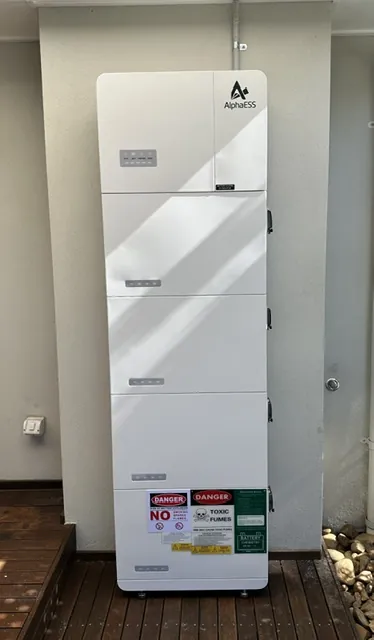
From one of our jobs
A completed home battery cabinet with isolation labelling
Photographed on site in Melbourne’s west. REC 37223.
The good news is that Newtown blocks are 600 to 900 square metres with a side driveway, so there is almost always somewhere sensible for a battery once you stop looking at the front of the house. The work is finding it and confirming the board can carry what gets connected to it.
What the heritage overlay means for a battery
The overlay controls what can be done to a building exterior, and a wall-mounted battery on a street-facing elevation is an alteration to that exterior. On a Newtown Hill or Clarkes Hill property that is a planning conversation before it is an electrical one.
In practice we avoid the problem rather than argue with it. A battery goes on a rear wall, in a detached garage or in an outbuilding out of sight from the street, which is where it belongs anyway for temperature and weather reasons. Where a job genuinely needs a permit we say so at quote stage, not on install day.
Out of sight from the street
Rear elevations, side walls behind the building line and outbuildings avoid the overlay question entirely.
Four precincts, not one
Newtown Hill, Newtown West, Newtown Chilwell and Clarkes Hill each carry the overlay, so the address matters.
Told before you commit
If a position needs a planning permit we say so in the quote rather than discovering it with equipment on the truck.
Old wiring and boards come first
Pre-1940s housing at this scale usually has rubber or cotton-braided wiring somewhere in the roof space and a board that was never designed for a modern kitchen, let alone storage. A battery installation adds circuits and normally a backup sub-board, and none of that can land on a board that has already been extended piece by piece.
We inspect before we design. Where an upgrade is needed it runs $800 to $3,500 or more depending on the supply arrangement and what is behind the cover. On a Newtown house that work is not optional and it should never be a surprise, so it goes in the quote as its own line.
Rubber wiring gone hard
Cotton-braided and rubber-insulated cable in the roof space gets found and reported before storage is designed around it.
Board work is its own line
Switchboard upgrades run $800 to $3,500 or more and are priced separately rather than buried in the battery figure.
Sequence it honestly
On some Newtown homes the board is this year and the battery is next year. That is a legitimate answer.
Detached garages and the length of the run
A Newtown block of 600 to 900 square metres usually has a single narrow side driveway to a garage at the rear. That garage is normally the right home for a battery, because it solves weather, temperature, UV and the overlay in one decision.
The trade is cable length. The run from the switchboard at the front of the house to a rear garage can be 20 metres or more, and on a battery installation that is a genuine cost line exactly as it is on an EV charger. It is also one of the main reasons two quotes for identical equipment come back at different numbers.
Measure the run
Switchboard to garage distance is a real cost input on a deep Newtown block, not a detail to sort out later.
Narrow driveways limit routes
The side gap between wall and boundary is tight here, which affects where conduit can be run and how it is protected.
One trip, two jobs
If an EV charger is coming later, running both cable paths while the trench or route is open saves paying for access twice.
Sizing against a large old house
Sizing comes from what the household uses between roughly 5pm and midnight, not from the size of the roof. Newtown houses are large and often poorly insulated by modern standards, so winter evening heating load is higher here than in a 2010s estate home of the same floor area.
That usually points to the upper half of the sensible 10 to 15kWh usable range, provided the array can actually fill it. Heritage roof planes are cut up by chimneys and the overlay limits street-facing panels, so the array is often smaller than the roof looks. A battery sized above what the panels can charge is money that never cycles.
Evening load sets the size
Your 5pm to midnight consumption in kilowatt hours is the number that decides capacity. Everything else follows it.
Check what the array delivers
Overlay-constrained roof planes mean a smaller array than the roof suggests, which caps the daily charging surplus.
The taper above 14kWh
Federal support reduces above 14kWh usable, so capacity beyond that has to justify itself on cycling alone.
Backup, Powercor and booking the work
A standard grid-connected battery shuts down during an outage. Backup needs backup-capable equipment, a gateway and a sub-board carrying nominated circuits, typically the fridge, some lights, the internet and a few power points. In a large Newtown house it is worth being deliberate about which circuits make that list, because the wiring is often original and not neatly grouped.
Newtown is Powercor, the same distributor that covers our own patch in the western suburbs of Melbourne, so the battery inverter application is familiar rather than novel. We are 65km away in Altona, so Newtown work is scheduled in blocks with a week nominated, not promised for the same day.
Circuits may need regrouping
Original wiring is rarely grouped the way a backup board wants it, so some rearranging is part of the job.
Application before installation
The battery inverter changes inverter capacity at your connection point, so Powercor approves it before energising.
Booked, not rushed
We travel 65km to Newtown. Work is planned into a scheduled block, which suits storage better than an emergency call.
On the ground
Newtown battery notes
- Newtown Hill, Newtown West, Newtown Chilwell and Clarkes Hill are heritage overlay precincts, so a battery visible from the street can be a planning matter rather than just an electrical one.
- The Clarkes Hill precinct alone covers 68 dwellings of which 54 are heritage significant, which is why we plan equipment onto rear elevations by default.
- Pre-1940s stock commonly hides rubber or cotton-braided wiring in the roof space, and boards extended over decades rarely have room for battery circuits and a backup sub-board.
- Blocks of 600 to 900 square metres with a rear garage give a good battery position, at the cost of a long cable run from a front switchboard.
Licensed and accredited work by a local team. Read about Pivot Trade Services or see recent jobs across the western suburbs.
Answers
Newtown questions
No, but it constrains where it goes. The overlay controls alterations to a building exterior, so a wall-mounted battery visible from the street can require a planning permit. Rear walls, side walls behind the building line and detached garages avoid that entirely, and they are better positions for temperature and weather anyway. We confirm the precinct before quoting.
Usually yes, and on a Newtown block it is normally the best position. A detached garage solves heat, weather, UV and the heritage overlay in one decision. The trade is a cable run of 20 metres or more from a switchboard at the front of the house, which is a genuine cost line rather than an afterthought.
Often not without work. Housing from the 1850s to the 1940s commonly has a board extended piece by piece and rubber or cotton-braided wiring somewhere above the ceiling. A battery adds circuits plus normally a backup sub-board. Upgrades run $800 to $3,500 or more, and we price that separately so you can see it.
Usually the upper half of the 10 to 15kWh usable range, because these houses are big and rarely well insulated, so the winter evening load is high. The limit is what your array can actually charge. Heritage roof planes are broken up by chimneys and street-facing panels are constrained, so the array is often smaller than the roof looks.
A 10kWh system is $8,000 to $12,000 installed before rebates and $5,500 to $9,500 after the federal Cheaper Home Batteries discount, which is roughly 30 percent at about $250 per usable kWh from 1 May 2026 and tapers above 14kWh. Switchboard work and long cable runs to a rear garage sit outside those ranges.
No. We are in Altona and Newtown is about 65km away, so we book work here in scheduled blocks and tell you the week rather than the hour. The battery inverter application still has to be lodged with Powercor and approved before energising, so storage is planned work either way. For a job like this, the distance costs you nothing.
Other work we do in Newtown
- Electrician in NewtownOverlay precincts, and what they decide before anything is mounted
- Solar installation in NewtownThe overlay decides where the panels go
- EV charger in NewtownA heritage precinct decides where the unit can go
- Split system in NewtownHeritage overlay first, capacity second
- Heat pump hot water in NewtownA heritage precinct decides where the unit sits
Get a Newtown quote
Tell us the address and what you need. We quote Newtown 3220 and the surrounding western suburbs in writing, with no obligation.
- Free
- On-site quotes
- Fixed
- Written pricing
- 100%
- Workmanship guarantee
- 5.0★
- 69 Google reviews