
Where the car park is usually not attached to the switchboard
EV Charger Installation in Central Geelong
Central Geelong is not a suburb of houses with driveways. It is a 19th century bluestone and brick commercial core with mid-century offices over it and, since the mid 2010s, apartment towers and large government buildings. Charging a car here is a building problem before it is an electrical one.
- Geelong 3220
- Powercor network
- REC 37223
The short answer
EV charger installation in central Geelong 3220 runs $1,200 to $2,200 on single phase and $2,500 to $3,000 plus where three phase is already present, which it often is in the 3220 core because the building stock is commercial and mixed use rather than suburban. Powercor is the distributor. City allotments sit hard against both boundaries, so the cable normally goes up an internal riser or in from a rear laneway instead of down a side path.
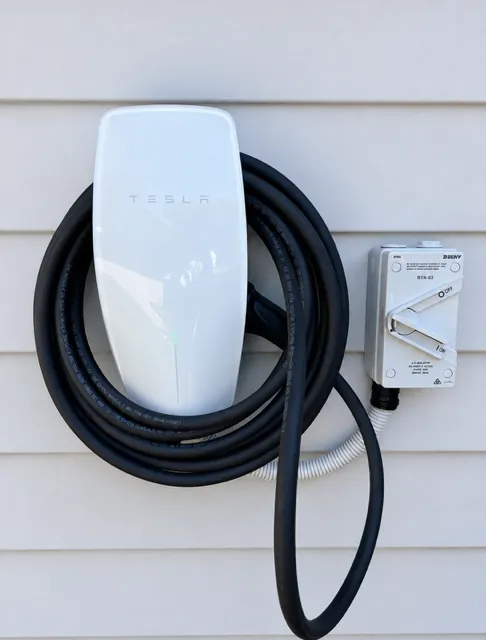
From one of our jobs
A Tesla Wall Connector on its own dedicated circuit
Photographed on site in Melbourne’s west. REC 37223.
That changes the whole shape of the job. Instead of asking where the meter box is on the side wall, we are asking which board your car space is fed from, whether the route crosses common property, and whether the building has spare capacity once every other tenancy is counted. We work central Geelong from Altona, about 60km, on booked visits rather than call-outs.
Find the car space first, then find the board
On a tight 3220 allotment built to the street and both side boundaries there is no side path to run a cable down. Parking is a basement or podium space, a rear laneway hardstand, or an on-street permit bay. Only the first two can take a fixed charger at all, and the third is worth saying out loud because nobody else will.
Where the space is in a basement, the run goes from a house board or your own meter position through the building riser to the space. That is usually the largest line on the quote and it is measured in metres of cable tray and conduit, not in charger brand. We walk it before we price it.
Basement or podium space
Fixed charger is possible. The route follows existing cable tray and risers, and the metres decide the number.
Rear laneway hardstand
Often the cheapest option in the core, because the run can come out the back of the building rather than up through it.
On-street permit bay
No fixed charger. We will tell you that at the enquiry rather than book a site visit you do not need.
Three phase is genuinely common in the 3220 core
In most of the region we spend the phase conversation talking people out of it, because residential streets are single phase and a conversion costs more than it returns. Central Geelong is the exception. Commercial and mixed-use buildings here are overwhelmingly three phase, and a lot of the apartment stock has three phase to the house board even where individual apartments do not.
Where three phase is already at the board and your car can use it, a 22kW capable unit is a legitimate spend at $2,500 to $3,000 plus rather than a vanity purchase. Where the supply exists in the building but your tenancy is fed single phase, the honest answer is usually a 7.4kW unit at 32A, which still adds roughly 40 to 50km of range an hour.
Three phase at the house board
Common in city buildings. It does not automatically mean three phase is available to your space.
Single phase tenancy
32A and about 7.4kW is the ceiling, which is 40 to 50km of range per hour and covers almost any commuting pattern overnight.
Check the main switch
Three phase present is not the same as three phase spare. We read the existing demand before specifying a 22kW unit.
Metering, tenancies and owners corporation consent
Mixed-use buildings in the city core frequently have metering shared or banked across tenancies, and the board feeding a car park is often not the board feeding your apartment or office. That matters because whoever is billed for the electricity has to be the same entity that agreed to the installation.
If the charger, the cable route or the space itself sits on common property, you need written owners corporation consent before anyone installs anything. This is not a reason to give up, it is a step. We produce the scope, the load figures and the route drawing that a committee actually needs to say yes.
Which board feeds the space
The answer decides who pays for the electricity and who has to consent to the work.
Common property routes
Anything crossing common property needs written consent. We supply the technical detail for the application.
Metered separately
A charger with its own metering or authentication solves the billing argument in shared buildings before it starts.
Load management is the tool that makes it work
Buildings in the city core were not designed with a car park full of chargers in mind. Adding one 32A load to a building already running lifts, air conditioning plant and a dozen tenancies can be fine. Adding six is often not, and the constraint shows up at the main switch rather than at your unit.
A load management device at $200 to $600 monitors total demand and throttles the charger instead of tripping the supply. In a multi-unit building, dynamic load sharing across several chargers is the standard answer, and it is far cheaper than the alternative of upgrading the building supply. Powercor can require it where the incoming capacity is constrained.
Single unit throttling
A $200 to $600 device that backs the charger off when the building draws hard, rather than tripping anything.
Shared across several bays
Multiple chargers split whatever current is spare. This is what lets a building add bays without a supply upgrade.
Powercor may require it
Where incoming capacity is tight, load management is the condition of connection rather than an optional extra.
Salt off Corio Bay, and what the quote covers
Waterfront buildings on Corio Bay carry genuine marine salt exposure, and it is the fixings, gland plates and the isolator beside the charger that go first rather than the sealed unit itself. In an underground car park none of that applies. On an exposed podium deck facing the bay it very much does, and we use stainless fixings and coastal rated glands there as standard.
Every EV charger install is prescribed electrical work. The charger gets its own final subcircuit back to the board, cable sized for a continuous load, a correctly rated breaker and RCD protection suited to DC leakage under AS/NZS 3000. There is no compliant version that shares a circuit with power points.
Single phase 7kW
$1,200 to $2,200 installed, with the upper end where the riser route is long.
Three phase 22kW capable
$2,500 to $3,000 plus, and only where three phase is genuinely available to your space.
Certificate of Electrical Safety
Issued through REC 37223 on completion, with commissioning details and a 100% workmanship guarantee.
On the ground
What we see specifically in central Geelong
- The 3220 core is commercial and mixed use, so three phase is far more available here than anywhere else in the region. It is the one part of Geelong where a 22kW unit is often the right answer rather than an upsell.
- City allotments are built hard to the street and both boundaries. There is no side path, so cable goes up an internal riser or in from a rear laneway, and the route is the price.
- Metering is frequently shared across tenancies in mixed-use buildings, which means the board feeding your car space may not be the board you are billed through. That gets resolved before anything is installed.
- Waterfront buildings on Corio Bay take real marine salt. Exposed podium and rooftop positions need stainless fixings and coastal rated glands, while a basement position removes the problem entirely.
Free download
The Melbourne Home EV Charger Buyer's Guide
What a charger actually costs, how to tell whether you need three phase, and the six questions that separate a real quote from a cheap one. Four pages, no email required.
PDF · 4 pages · 2026 edition
Licensed and accredited work by a local team. Read about Pivot Trade Services or see recent jobs across the western suburbs.
Answers
Geelong questions
Usually yes, but it needs owners corporation consent in writing because the route and often the space itself are common property. The technical questions are which board feeds the car park, whether the building has spare capacity, and how far the run is from that board to your bay. We produce the scope and load figures a committee needs before they vote.
Yes, and it is the genuine exception in this region. The 3220 core is commercial and mixed use rather than suburban, so buildings here are overwhelmingly three phase. That does not automatically mean three phase reaches your tenancy or your car space, which is what we check on site before quoting a 22kW capable unit at $2,500 to $3,000 plus.
Often not. Dynamic load sharing across multiple chargers splits whatever current the building supply can spare, so bays get added without touching the incoming service. Powercor can require load management as a condition where capacity is constrained. It is dramatically cheaper than a supply upgrade and it is the standard approach in multi-unit buildings now.
A fixed home charger is not one of them, and we will say that at the enquiry rather than book a site visit. Nothing can legally run across a footpath to a permit bay. Realistically you are looking at public charging or a charger at work, and if you later secure an off-street space we can quote it properly then.
No. We work central Geelong from Altona, about 60km, and we book Geelong jobs in scheduled blocks rather than promising same-day attendance. We nominate the week rather than the hour. For a planned charger installation that changes nothing except the calendar, and it is the honest version of what we can actually deliver.
Yes. Powercor runs the network here as it does in our own area, and a charger is a load addition the distributor is told about through the connection process. Where the incoming supply is constrained, they can require the charger to be load managed rather than approving unrestricted current. We handle that paperwork as part of the job.
Other work we do in Geelong
- Electrician in GeelongScheduled city work, booked in blocks from our Altona workshop
- Solar installation in GeelongCity roofs, rooftop plant and the building next door
- Home battery in GeelongScheduled work in the city, booked in blocks
- Split system in GeelongApartments, laneways and nowhere obvious for the outdoor unit
- Heat pump hot water in GeelongScheduled work in the city, 60km from our Altona workshop
Get a Geelong quote
Tell us the address and what you need. We quote Geelong 3220 and the surrounding western suburbs in writing, with no obligation.
- Free
- On-site quotes
- Fixed
- Written pricing
- 100%
- Workmanship guarantee
- 5.0★
- 69 Google reviews